The Library Book by Susan Orleans
This is ostensibly the story of the 1986 fire that ripped through Los Angeles' Central Library, but is really about much more. The book's 30 chapters alternate between three different perspectives. In one, Orleans tells the history of libraries in Los Angeles, helping to explain how the Central Library came to be built in the 1920s and its near-demolition in the 1970s and 1980s after years of neglect. Another focuses on the fire itself and the search for the person who set it, which investigators finally believed to be Harry Peak. Finally, Orleans sprinkles in short vignettes about the librarians who work at the library.
The history of Central Library was more fascinating that I thought it would be. One forgets how recently Los Angeles sprung out of the desert. A library -- not a standalone building -- was first opened in the place in the late 1800s. I was surprised by how progressive its head librarians were from the get-go. They seemed on a mission to reach out to the community from the very first, hellbent on upending any elitist pretensions people might have about who should have access to information. There were several characters as well, chief among them Charles Lummis, who appeared in Los Angeles in the 1880s to take a job at the LA Times. When he was hired, he was working in Ohio. Rather than take a train to LA, he decided to walk, capitalizing on the choice by writing a weekly column on his adventures that made him famous even before he arrived in his new town. His notoriety, and his sex, earned him the job as LA's librarian when the board decided to let go of the highly competent individual in the position because she was a she. That she, Mary Jones, did not go away quietly, instead fighting what became known as the Library Wars for her position. She lost. Lummis was fired, lasted a few good years and then was himself let go.
The story of the fire was also more interesting than I might have suspected, particularly in light of new approaches to arson investigations. Apparently, it used to be, and still is in some places, best practice to call something arson if no obvious other cause could be found. That is, if it could not be definitively proven that a fire was started by wiring or a faulty appliance or some such thing, it was declared arson. Unfortunately, investigators were often relying upon faulty assumptions when looking for the origin of a fire and so often overlooked the real cause of a fire. For instance, it used to be assumed that a fire burned the hottest at its origin. But that is apparently proven not to be the case. So now there is a national movement to free people wrongly convicted of arson. One man was in prison for the murder of his daughter for a fire he never set. This has impacted thousands of people. I had no idea!
There is a reason, though, that the book is not titled The Los Angeles Library Book, for all of these perspectives are really a chance for Orleans to explore the role that libraries have and will continue to play in our lives. Often thought of as mere lenders of books, libraries, particularly those in big cities, are in fact much more than that. Orleans focuses heavily on the role that libraries play for disadvantaged populations, particularly the homeless, for whom Central Library and thousands like it are a haven, a source of entertainment, and, in some cases, a way to connect to vital social services. In the end, I think it is this connection that Orleans argues that libraries, and the books within them, provide. They connect people to each other, to writers, to information and ideas, and, in the case of Central Library, to art. As Orleans closes, "Even the oddest, most particular book was written with that kind of crazy courage -- the writer's belief that someone would find his or her book important to read. I was struck by how precious and foolish and brave that belief is, and how necessary, and how full of hope it is to collect these books and manuscripts and preserve them. It declares that all these stories matter, and so does every effort to create something that connects us to one another, and to our past and to what is to come."
Wednesday, January 23, 2019

Neverwhere

Neverwhere by Neil Gaiman
In this book, Gaiman brings to life a world "underneath" the world we walk around in every day. Londoner Richard Mayhew encounters London Below one day on his way to dinner with his fiance, Jessica. They come to a girl who is clearly in distress and, over Jessica's objections, Richard brings her back to his apartment to help her recuperate. Little does Richard know that the girl, Door, is from London Below and that his contact with her banishes him from London Above -- that "normal" London he is used to -- and send him to London Below, which Gaiman explains is made up of souls who "fell through the cracks". Once there, Richard manages to find and join Door, who is on a quest to avenge the murder of her prominent family, all the while trying to go back to his old life. Along the way, he encounters all sorts of strange creatures and, of course, learns much about himself.
Gaiman clearly had fun creating London Below and imagining a world turn on its head. That makes it fun for the reader. And even if the plot is a little predictable, Gaiman nevertheless does a great job of keeping us wanting more. It's a world and a story to get lost in, and sometimes that's exactly what you want from a book. And there is something of a message: It seems to be that there is much fun and adventure to be had outside of the type of robotic life that Richard has at the beginning of the book. Our failure to find them might just be a failure of imagination.
Saturday, January 12, 2019
Cold Mountain
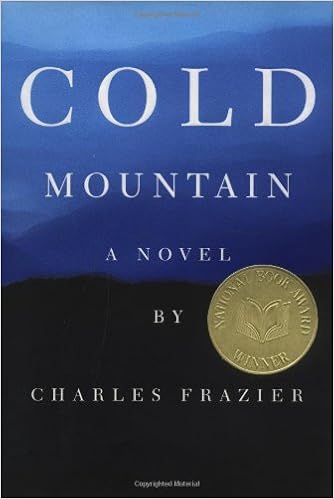
Cold Mountain by Charles Frazer
Set in the waning days of the Civil War, this story is told from two, alternating perspectives. Inman is a Confederate soldier who, after suffering a wound at Petersburg and witnessing the horrors of war for nearly four years, decides to leave his hospital bed and journey home before he can be sent back to the front. He is driven by the hopes of reuniting with the other character, Ada, with whom he sparked a brief relationship before heading off to war. Despite leaving the fighting of the war, Inman's journey is nevertheless full of danger and violence. Instead of dodging bullets from Union guns, he now has to avoid the Home Guard, a group of wealthy planters and other men somehow exempt from military service who have made it their mission to capture -- and kill -- any and all deserters from the army who cross their path. Meanwhile, Ada has tribulations of her own. Her father recently died, leaving her penniless and with a mountain farm that she has no idea how to manage. Enter Ruby, who is as savvy and underprivileged as Ada is clueless and (formerly) rich. Together, they begin to put the farm to work and make plans to survive the coming winter.
I originally picked this book up because I'd heard of the movie version and because it bore a National Book Award medallion on its cover. Generally, the award is a sign of a great book. I'm not sure this was that. It was certainly engaging and drew me in, but, as many other critics have pointed out, the pace of the story is s-l-o-o-o-w. The book probably could have been a hundred pages or more shorter. And, oddly, the climax of the book, which comes very near the end, receives very little ink. It was odd that the moment the entire story built to passed so quickly. It made the ending seem abrupt, as if it were an afterthought. That said, I always find this period of history to be intriguing, and this one taught me something. I hadn't realized the extent of the terror of the Home Guard, which seemed in many ways like a prototypical KKK. If you're in the mood to return to the 19th century, this book will bring you there. But you could easily skip it and not miss much.
Wednesday, December 26, 2018
The Power

The Power by Naomi Alderman
What if traditional gender roles were reversed? That's the question that is at the heart of Alderman's novel. It imagines a world in which women, suddenly, obtain a new power, a "skein" between the collar bones that hums with electricity, which they can use as a weapon. And they do. All of a sudden, men are at women's mercy; it's as if every woman in the world were walking around with a concealed, loaded gun. Naturally -- or, so the author seems to suggest -- women begin to use the power to upend gender norms and, essentially, seek revenge for hundreds of years of injustice and compelled subservience. At first, the reader, at least this reader, was rooting for them. Don't women deserve to be finally liberated in this most physical of ways? But the power doesn't necessarily serve humanity well. Interestingly, the book is framed by an e-mail exchange between the author and a fellow writer many years -- 5,000, I think -- in the future. The conceit is that the story is one anthropologists attempt to bring otherwise boring history to life, to explain how their matriarchal society came to be. So the story, which takes place in our future, actually takes place in the past for its fictional author. This, I think, is key to elevating the story. It helps contextualize the tale and give it resonance beyond its characters.
But what, exactly, is its meaning? And here I warn any reader who happens upon this blog that I am about to reveal too much about the plot. So here's what happens: Women who are desperate to liberate their fellow women from male domination essentially help bring about the total destruction of civilization so that it can be rebuilt with women in charge, a history which is only revealed in the epilogue e-mail exchange between the fictional author and their fictional writer-adviser. In this exchange, the fictional author, a man named Neil, defends his depiction of the origin of their society to another writer, Naomi. She finds several aspects of the book just plain silly: Could it be that there were battalions of male soldiers? The point is that the society in which the two are writing has gender norms that are the exact opposite of our own. Women are seen as more aggressive and strong while men are weak and passive. So what is the real author saying? At first I thought it was merely: Absolute power corrupts absolutely. (Obviously not a phrase I coined.) But maybe it's an attempt to show that men and women aren't that different, that we all act according to the gender roles we are assigned, that women could just as easily be the warriors of the world if that's how the world saw them. Or maybe that the very real differences between men and women will inevitably lead to such gender norms? Or maybe that our societal norms are as much based in mythic as the ones the society developed in the novel are?
Regardless, this was a book that was at once hard to put down because the plot drew me in so intensely, and had me thinking more deeply about our society. A good read!
Tuesday, December 18, 2018
The Final Solution
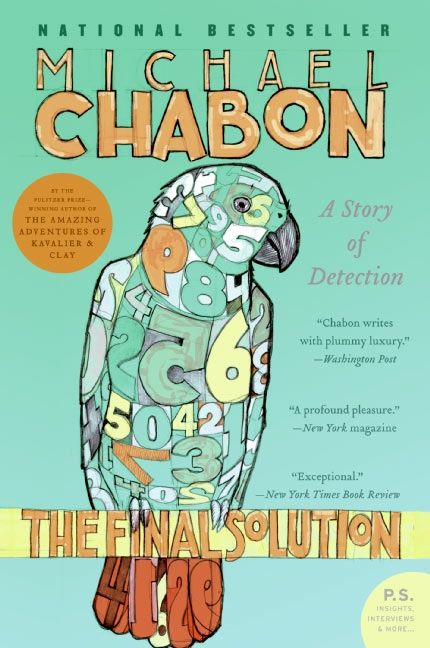
The Final Solution by Michael Chabon
This slender mystery is set in World War II-era England. It features a mute Jewish boy who escaped Nazi persecution in Germany and his loquacious parrot. It is what the parrot says that is the heart of the caper: Over and over again, it rattles off a series of numbers in German. There are various theories about what these numbers might mean: A Nazi intelligence code? The numbers of a fabulously full bank account? Nonsense? This intrigue leads to a murder that brings an aging Holmes-like detective who was once renowned for his attention to forensic details. In the end, the reader has a good idea about what those numbers might mean, but nothing clearly definitive.
I can't say I was particularly taken with this novella. I think it's greatest achievement was the tone Chabon managed to hold throughout. It is very different from his other novels, a clear homage to Doyle's classic detective novels: it is stiff, Victorian language. That part was fun. But, perhaps owing to its length, I never found myself lost in the story. The characters felt like caricatures, and the plot unfolded so suddenly that you never had time to be shocked or surprised. Suspense is, after all, the bread and butter of mysteries, but it was almost entirely lacking here. Not recommended.
Monday, December 17, 2018
Educated

Educated by Kara Westover
Another book about the meaning of family, this time in memoir form. In the book, the author tells the story of her journey from an off-the-grid home in Idaho, where she was raised -- bullied? abused? -- by fundamentalist Mormon parents who avoided the "government" at all costs, to the highest ranks of academia. Despite no real schooling -- she reports that her parents had essentially given up on "home schooling" by the time she, the youngest of seven, rolled around -- she now has a PhD from Cambridge. There is much to that journey, of course, including a delusional father and physically abusive brother. And in the end, her family rejected her attempts to right the most egregious wrongs of her upbringing.
After reading reviews and interviews with the author, it seems as though most people are fascinated with the idea that, even in the 21st century, it is possible to grow up as isolated as Westover did. But I've lived in and visited many places where it was clear this is possible. My brain and eye was focused on the "educated" part, particularly when Westover first encountered "formal" education at BYU and then Cambridge. These portions of the book do not speak well of "higher" education. In both instances, Westover describes having to take tests in which she was asked to regurgitate information from lectures in which professors pontificated on various subjects. In fact, it isn't until after six years of schooling that, at Cambridge, Westover says that instead of being asked to read history, she is asked to write it. In other words, she wasn't asked to think for herself for six years of college. This is likely an exaggeration, but regardless of my hyperbole, it is clear from the memoir that what Westover describes as her "teachers" were really "tellers". That is, they sought to help students learn by telling them what they knew. But this isn't teaching at all. It is the simplest thing in the world to tell someone what you know. It is much more difficult, but ultimately more meaningful, to devise learning experiences in which students arrive at what you know on their own and then use this knowledge to form opinions about the topic at hand. So while many might see this book as a a tale of the triumph of "education", I think it tells a far less optimistic tale about the role that our educational institutions play in people's lives.
What is remarkable about this book is that it is, at least in the words of the author, true. It is incredible that someone's life could unfold in such a suspenseful way. No one should have to live a life like that. No one should have to wonder whether they will be hurt one moment or rejected from their family for expressing fear the next. While Westover's success is certainly inspiring, that she had to go through so much to achieve is is rather heartbreaking.
Far From the Tree
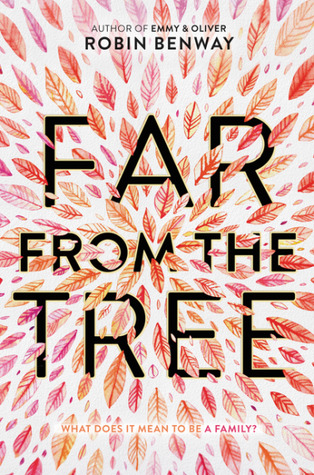
Far From the Tree by Robin Renway
This is my kind of book. It tells the story of three adopted teenagers (Grace, Jaoquin, and Maya) who find each other when they need it the most -- which sounds kind of sappy, and is not what I mean when i say that this is my kind of book. What I loved about this story was the way it let me inside the minds and personalities of the characters. I think more than anything else what I look for in a book is some kind of insight into my fellow human beings. I have a hard time with that in real life; I don't know what makes people who are different me -- and most everyone is different than me -- tick. This book immerses you in the characters. You feel like you know them. This is particularly true when the author uses dramatic irony, which, my wife informs me, is when the author gives the reader more information than the characters. In those moments, you understand what the other character is going through, know how hard it is to be themselves at that particular time.
I will say that the book is more disappointing in fulfilling the other duty I hope a good work of fiction will fulfill, which is to illuminate something of the human condition. The subtitle of the novel -- What does it mean to be a family? -- largely goes unanswered. Or it is answered in a far too simplistic sense. Somehow, the characters are all experiencing some kind of crisis in their lives when they meet. And somehow, despite never knowing each other, the genetic draw between them is enough for them to become a rock-solid support group at this critical juncture. Of course, it never happens -- or, I guess, I can't imagine that it happens, since I myself was not adopted -- this neatly. Even worse, the characters all seem to reach some sort of resolution by the end of the book, which purports to take place in a short period of time. Perhaps resolution occurs in some lives, but it is not something I've experienced. When one problem is solved, others present themselves, either externally or, in most cases, from within. This is the nature of life; it doesn't stop. Nor should it. If you aren't challenging yourself, pushing yourself outside of your comfort zone, if you aren't discontented in some way -- what's the point? I guess?
Anyway, this is a great read. Perfect, no. But highly entertaining and worthwhile.
Subscribe to:
Posts (Atom)