Sunday, February 18, 2024

North Woods

North Woods

By Daniel Mason

Wow. That was quite a book.

The novel tells the story of a piece of land in Massachusetts' Berkshire Mountains through the eyes of its


inhabitants over four centuries, beginning with a pair of Puritan lovers who flee the, well, puritanical, mob that would have their hides for their deeds. They establish a little cabin, soon only inhabited by the former bride, who welcomes another "Englishwoman" kidnapped on a raid by Native people. A scuffle with a party of murderous soldiers leaves only the newcomer, and thus begins a succession of owners: an army major, Osgood, obsessed with a wondrous variety of apple found near the cabin; his daughters, Alice and Mary; a once-famous landscape painter; a wealthy hunter; his daughter and son, who is wracked by schizophrenia (or a psychic gift?); and, finally, no one. No one living, that is.

For many of the former inhabitants of this land, and the increasingly sprawling home that sits upon it, become ghosts upon their deaths. Not all. But enough. Mary, for instance, dispatches a slave hunter with an axe just as he is about to corner his escaped quarry. And the painter, William Teale, can be heard reciting poetry and copulating with his male lover, a relationship he was only able to glimpse briefly in life. The rules for who becomes a ghost and who does not are a little unclear. Mary, Alice, and Teale, were all prevented, by their partners, from the form of self-actualization that might bring them happiness, and so died able to image this state but unable to attain it. Osgood, though, seemed quite content with his life, and yet he also lingers in the place. 

And what to make of Robert, the mid-20th century inhabitant diagnosed with schizophrenia whose seemingly wild ramblings he calls "Stitches" because he believes his steps literally keep the earth stitched together. He talks of enemies and allies that others perceive to be little more than paranoid hallucinations. And yet his sister, upon Robert's death, finds a stash of 8 mm tape with titles like "Major Osgood's Remembrances of the French and Indian War". To the sister, they are soundless shots of the property; but we, the reader, know of Osgood and his experiences, and are left to wonder whether perhaps Robert's disease was perhaps just a gift, and ability to interact with the ghosts all around us that the rest of us don't. 

But, really, this book is about the land. For while we talk about forest "succession", what that really means is death. It's not just the way some of the inhabitants cut the woods or slash the apple trees. It's the attackers from far away -- the fungus, for instance, spread after a quite detailed and humorous description of beetle sex, that kills the elm and the chestnut, and disfigures the beech -- that have slowly dismantled and diminished the north woods. And not just the trees! Apparently, we have lost 1/3 of our birds since the 1970s, reducing the sound of our once-great forest to a mere hum. At the books' end, the author describes the upward creep of southern pines, which, if our climate continues, will inevitably "succeed" -- and kill off -- our fragile north woods.

This last part was a bit hard to stomach. But this winter (most winters, actually) it is hard not to focus on the loss wrought by climate change. We have yet to have a significant snowfall, and our 5" "powder days" do indeed seem like ghosts of what used to be. Perhaps that's melodramatic. I can't help but wonder, though, whether my kids, who will have grown up spending their winter days at the mountain, will even be able to ski in these parts when they are my age. It makes me wonder, too, about the change my grandfather saw. He was born in 1912 (I think?), and loved the woods, albeit the ones in upstate New York. Did he see the great elms I've been told once lined every downtown in America? Did he see great stands of chestnuts? Did he mourn their losses the way this author does?

Depressing though the book might seem to be, it is engrossingly told. Each vignette brings us wholly into a character, who is imbued with their own voice. There must have been a lot of research into the particular vernacular stylings of each time period touched upon. And the ghost conceit keeps you wondering when they will pop up next. What a great read.

Sunday, February 11, 2024

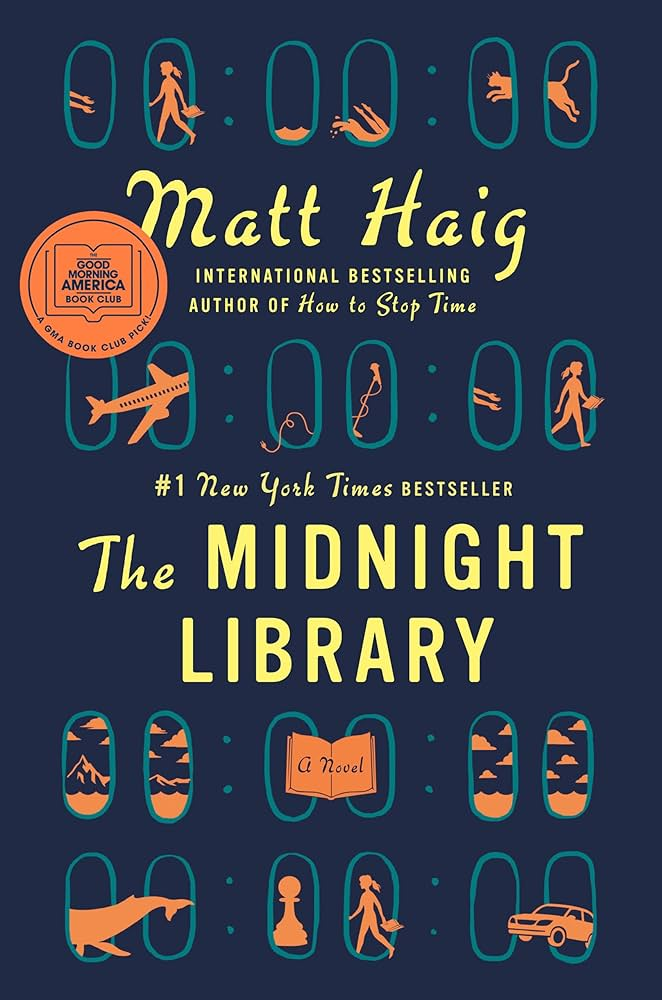
The Midnight Library

 The Midnight Library

By Matt Haig

Nora Seed is having a bad day. She's in the midst of a bout of depression when she loses her low-paying


job at a music store -- basically for showing up depressed. Then she misses a music lesson with her only pupil, who decides to quit the instrument. And, finally, her cat dies. It's all too much for Nora, who once had the world at her fingertips. She was the top swimmer in the country. She did well at university. She even had a music contract with her band, The Labyrinths. Full of regret and without hope, she decides to take her own life.

Except it doesn't quite take. She winds up in the "Midnight Library", essentially a figment of her brain, where, as long as it stays midnight, she can try out the lives she would had lived had she made different decisions. She becomes an Olympian, a rock star, a glaciologist, a professor of philosophy, only to find that none of these lives are all they are cracked out to be. Finally, she realizes -- shocker -- that her "root" life is the one she really wants to live.

I can't say I thought much of this book. It was all so cliche and predictable. The life skipping thing seemed like a replay of "Quantum Leap". And it was pretty clear where this was all headed. Value life! Even the mechanics of the midnight library were clunky. Nora drops into a life with no idea what is going on, so she's not really living that life or that person. It all felt pretty silly, and it was a slog to get to the end.

Wednesday, January 31, 2024

Solito

 Solito

By Javier Zamora

This was a hard but fascinating read. It's a memoir that tells the tale of his migration to the United States.
Zamora is born in El Salvador, where he is raised by his grandparents because both of his parents migrated to the US when he was very young. His life in El Salvador actually seems pretty okay; he hints at poverty, but we didn't really see it. Nevertheless, Javier's life is consumed by a dream to be reunited with his parents, with whom he speaks once every two weeks.

At last, his day comes. Javier is 9. He is led north with five other people by a coyote named Don Dago, who disappears from the trip not long after it begins. He has told the group he will meet them after an 18-hour boat ride from Guatemala into Mexico. But he never appears. Yet The Six, as Javier dubs them, continue on their journey, and are shuffled from coyote to coyote, who seem to care for them and follow through on their promises. 

Finally, they reach "la linea" -- the border with the US. The Six join a group of about 50, who are surprised by La Migra just as they are about to reach their destination. Javier is now one of four: a man, Chino, a woman, Patricia, and her daughter, Carla. These three care for Javier as if he is family, and they try again. And again they are caught, this time by a border patrol agent who brings them back to the border, but doesn't put them in a cage, as Javier describes a jail. 

But third luck proves the charm, and Javier eventually does make it to La USA. We learn little about his life there, except that he eventually loses touch with Chino, Patricia, and Carla, and that he had years of therapy to deal with the trauma of his crossing.

The book stirred a lot of emotions. The compassion that Chino and Patricia show Javier is inspiring. They save his life on numerous occasions. But none of the coyotes ever make contact with Javier's family, leaving them wondering and worrying for weeks. And then there is the immigration system that the migrants bump up against. They are so desperate to come to our country, and we treat their dreams so callously. I don't know what the answer is, but this book makes it clear that we need to do better.

The Strange Library

 The Strange Library

By Haruki Murakami

By now, I've exhausted all of the Murakami at the local libraries except this one. It's quite short, and took


only an evening to read, so it wasn't quite the immersive experience I was looking for. But it certainly lived up to its title!

The novella tells the story of a man -- a Murakami man! -- who wanders into a library looking to check out books. He is directed to a basement, where and old man leads him into a labyrinth and demands he check out a book. The narrator, who was more in the mood to browse than anything, is incredibly passive and gives into the old man's demands, even when he is taken deeper underground into a reading room that winds up being a jail cell. The assignment there: Read two books on tax collection in the Ottoman Empire and pass a test on it to be released. At first, he complies, but then the person who brings meals -- delicious meals, it turns out -- reveals that all of this reading and memorizing is just to make his brain more tasty and delicious and that, whether he passes the test or not, his gray matter will become a meal for the old man.

Then a young woman appears. There's always a young woman, isn't there? And she helps him escape the library to safety.

Very strange. But not long enough.

Wednesday, January 17, 2024

The Borrower

 The Borrower 

By Rebecca Makkai

I picked this one up based upon the binge-worthiness of Makkai's most recent novel, I have some


questions for you.
 If Richard Russo's quip on the front cover is to be believed, this is her first novel. 

The protagonist-antagonist of this book is Lucy Hull, a children's "librarian" -- quotes because she never received her library science degree -- in Hannibal, MO, who develops a close relationship with one of her patrons, or borrowers, named Ian Drake, a voracious reader living under the strict thumb of a conservative Christian mother. So Lucy slips Ian books every now and again that she thinks he will like. Until.

One day, Ian gives Lucy a piece of origami as a Christmas present. When she unfolds it, she sees a testimonial written by Ian's mother about her son's participation in a gay-conversion therapy run by a prominent pastor. Lucy is horrified, and suddenly obsessed with her young friend's plight. So when she finds him camped out in the children's room of the library one morning after running away from home, she is torn about what to do. She half-heartedly tries to drive him home, but when it is clear he is jerking her around -- and that he DOES NOT want to go home -- she just keeps driving. And driving. And driving. To Chicago and Cleveland and Pittsburgh and Vermont. So now Lucy is the "borrower". 

The journey takes up the bulk of the book, and I will say it was a bit excruciating to read. I mean, it's such a horrible decision on so many levels and clearly nothing but doom awaits. And there are really no hints that anything else is coming. It's like watching a slow motion car wreck for two hundred pages. Things improved after a stop in Pittsburgh, where Lucy learns an important secret about her father, who nearly lost his life fleeing the Soviet Union, and it becomes clear that the trip is as much about Lucy rescuing herself as it is about her rescuing Ian. 

I will say that the ending was a bit too tidy and happy. Somehow, Lucy gets away with it. Which is just impossible. A kid goes missing for over a week, shows up again on a Grayhound -- somebody is going to jail. So that was disappointing. But, over all, a pretty good read.

Friday, December 29, 2023

A Great Reckoning

 A Great Reckoning

By Louise Penny

In my reading world, the arrival of December means an annual reunion with Armand Gamache and his


loyal cast of characters in Three Pines.

This edition finds the Gamaches living in Three Pines as Armand prepares to begin a new chapter of his career as Commander of the Sûretè Academy. I'm a little unclear about where this book falls chronologically in the Gamache bio, but I did read about how he took down the head of the police force, Franceour, who had been corrupt and filled its ranks with like-minded individuals. Gamache saw the academy as the training ground and ultimate source of this corruption, and his goal in taking it over was to right the ship, and restore order to the Quebec police force for years to come.

In what might be described as an act of arrogance, though, Gamache kept one of the most corrupt of the academy's faculty, Serge Leduc, on staff, and hired one of Franceour's right-hand men to join them. His reasoning was that the two might cancel each other out, and serve as living examples of the pitfalls of corruption. It didn't quite work out that way.

Shortly into Gamache's tenure, Leduc is murdered on campus. Gamache brings on his accomplice in the Royal Canadian Mounted Police to serve as an independent witness to the investigation. Not surprisingly, he tries to peg the murder on Gamache. But just as he is about to make the arrest, Gamache, newly aware of just how twisted Leduc had been -- he made cadets play Russian roulette! -- proves his corruption and finds the real killer -- Franceour's former ally. Just in the nick of time, as per the usual.

So wonderful to be back in Penny's world again. She sure knows how to twist a tale. I found myself reading until well past my bedtime, which is just what I need this time of year. And after four -- five? -- of these books under my belt, the characters feel like old friends. Till next year...