Monday, March 24, 2025

Martyr!

 Martyr! 

By Kaveh Akbar

Death is a constant in the life of Cyrus Shams. His mother died when he was an infant, her plane, mistaken


for a fighter jet, shot down by the US Air Force. Some 20 years later, his father followed, though he was dead in many ways before his body expired. Cyrus seemed destined to die young too, and made something of a past time of consuming substances -- anything, really -- that seemed sure to accelerate this process.

Until. One day, out of his mind on something, a bulb hanging from his ceiling blinks, and when he wills God to make it happen again, it does. Henceforth, Cyrus becomes sober. But sobriety can only take him so far. He is convinced that his life has no meaning and, from the outside, it's a bit hard to argue with him. He is a perpetual student, a writer who barely writes with no real plan or aspirations for the future. Yet he yearns to imbue his life with purpose.

Then the bulb blinks again. A show opens at the Brooklyn Museum called Death Speak in which an artist, Orkideh, who is diagnosed with terminal breast cancer, sits in a room and speaks with whoever wishes to about life and death. Here, thinks Cyrus, is a woman whose death with have meaning. He launches a writing project about martyrs, flies from Indiana to New York, and meets with her regularly. He is surprised when she goes out of her way to invite him back, and so he returns two days in a row. She hints at knowing something about his mother and her death, which spooks him. He ruminates on it -- how could she know? -- and vows to ask her about it the next day.

Except the next day, Orkideh is dead. Twice. Once when her body expires, and once when Cyrus learns the truth about who she is: his mother. She had been trying to leave Iran with her lover, who took on her identity to fly out quickly to escape her more acutely intolerant and intolerable husband. When the lover dies, Cyrus' mother leaves anyway and builds a new life for herself in New York. Without Cyrus.

Suddenly, Cyrus' whole world view crumbles. His mother, who he had thought died a meaningless death, actually died what he considers to be a meaningful one. They coexist at the same time. Or do they nullify each other? 

It is enough of a twist to shock Cyrus out of his self pity and into the world, perhaps for the first time. 


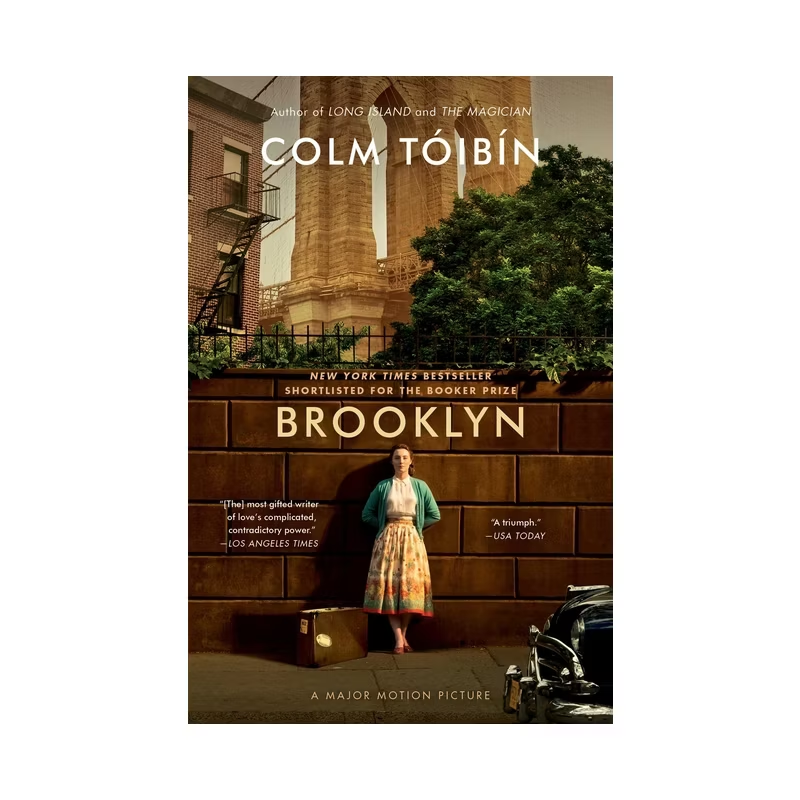
Brooklyn

 Brooklyn by Colm Toibin


Sunday, March 9, 2025

Lazarus Man

 Lazarus Man by Richard Price

Can't say I thought a whole lot about this one. The title refers to the main character, whose life takes an


abrupt turn when he is found alive in the rubble of a collapsed building after 36 hours under a chunk of concrete. Miraculously, or so we think, he emerges unscathed. He becomes something of a folk hero, who is sought out to give speeches. He finds that he has something to say, and that he can express his thoughts in a way that moves people. He is a new man, and is able to move on from a downward spiral of a life that had descended into cocaine addiction. Turns out, though, he is something of a fraud. Footage of the collapse taken by a camera-obsessed local resident spots him running about in the immediate aftermath. So how did he end up under the concrete? He was tired, and lay down. Nevertheless, his words are true, and they help various other characters rise from the ashes of their own train-wrecked lives. 

I found this book a bit plotless and predictable.

Sunday, January 26, 2025

In the Distance

In the Distance

By Hernan Diaz

My 150th entry! It took a little longer to get here than I anticipated, but a milestone nonetheless.

I picked this book up primarily because of how much I enjoyed Trust, the last book I read by this author. That work felt a lot like a crossword puzzle, which I find myself trying to unlock more frequently of late. It featured basically the same story told from four different, sometimes intertwining, points of view. It's not an uncommon method, but the way he wrote it made it take a while to figure out what was going on. And even by the end, you don't really know who to believe.

This book was much different, but no less interesting and, at times, riveting. It is, as the dust jacket explains, a book that "defies the conventions of historical fiction and genre." It is a tale of the settling of the west, with a twist. The main character, Hakan, or The Hawk as he becomes known, wants desperately to get east. After setting out with his brother from Sweden, he somehow becomes separated and winds up on a boat bound not for New York City but for San Francisco. When he arrives there, he becomes determined to reunite with his brother and takes up with an Irish family in search of gold. Against all odds, they find it -- only to have it stolen from them by a powerful woman from a nearby town who takes a liking to Hakan and keeps him as something of a sex slave.

He escapes, and spends much time wandering the desert, taking up with a scientist in search of the first signs of life on planet earth in the salt flats around what I can only assume is Utah. The scientists' help becomes tired of the desert mission, and, when he stops to give assistance to a recently-attacked group of Native Americans, they leave him. Hakan stays, and for his efforts he is gifted some medical training and tools, as well as a horse, which makes his journey much faster.

Eventually, he runs into settlers on the Oregon trail. One day, he is offered another horse, this one strong and healthy, if he would only serve as a bodyguard to a confidence man who has somehow convinced many settlers that he has land in Oregon that he can give them, which prompts many to shower him with gifts from their meager possessions. One day, they run into a band of Native people, or so they think. In fact, it is a ruse; a group of "brethren" (Mormon's?) who pretend to be Native and then change clothes to chase them off. The settlers fall for it, and welcome the "heroes" into their wagon circle. Whereupon they are fired up on indiscriminately. Hakan, who is an enormous human, reacts quickly, and almost single-handedly defeats the brethren. 

Word of his deed spreads far and wide. He is a hero! He is a villain! He goes into hiding. For years, his legend grows outside of his isolation. He grows too, never stopping. He is, it seems, the embodiment of the western tall tale, growing taller with every telling. Even years and years after the event, he is recognized and almost taken captive once more. He manages one more escape, does a kind deed for a fellow Swede who has come into wealth and funds a trip to a place where he won't be recognized: back home. 

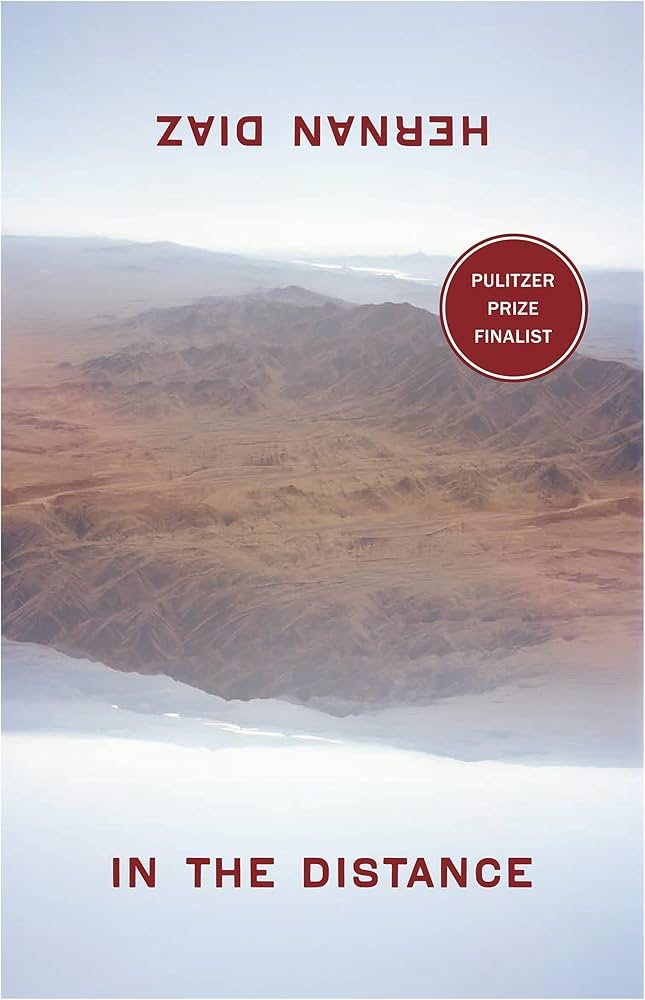
The cover of the book is a mirror image. A mountainous desert landscape above; the same desert landscape below. I will admit that I was a bit too involved in the plot of thee book to fully consider its message, but that image seems a key to it.

Friday, January 10, 2025

The City and its Uncertain Walls

 The City and its Uncertain Walls

By Haruki Murakami

A new Murakami novel! Well, actually, only partly new. This is an extension of one half of the novel Hard
Boiled Wonderland and the End of the World, which was actually two novellas combined into one. Anyway. It arrived just in time for my annual Murakami read, and I was excited to pick it up.

Part 1 of the novel felt almost exactly like what I'd read before, which was a little disappointing. It was surprising to read in an afterward that he almost stopped there, because it didn't seem like there was much new. A 17-year-old falls in love with a 16-year-old, who claims that she is just the shadow of a real person living in an alternate world, a small city surrounded by a wall where time has no meaning, every day is basically the same, unicorns roam the streets, and no one may leave or enter. The pair carry on an intense relationship, but one day the girl simply stops replying to his letters and seems to disappear. Soon after, this version of Murakami man finds himself there one day at the bottom of a hole that the gate keeper to the city usually uses to burn the bodies of the beasts (unicorns) who die off during the harsh winter. Gotta love the Murakami man in a Murakami hole! To enter the village, the man must be separated from his shadow. His eyes are scarred so that he can fulfill his function: to read dreams that are ensconced in old skulls in the city "library" -- where the "real" version of the girl he loved was supposed to work. He visits with his shadow regularly, and becomes concerned when it seems that his shadow is dying. They make an escape plan, hoping to get back to the other world at the bottom of a mysterious, swirling pool in a river that runs through town. They make it, but the man decides at the last minute to stay back.

Or does he? The novel picks up back in the man's life, but something is a bit amiss. He aimlessly wanders into his 40s and decides he needs a change. He finds a job as a librarian in a small town several hours from Tokyo. He is befriended by his predecessor, who, it turns out, died a year before his hiring; he is, in fact a ghost. And, of course, they meet in the bowels of the library -- kind of like a hole. The shadow makes a few acquaintances in the town, including a woman who runs a coffee shop but, perhaps more importantly, a boy who dresses every day in a Yellow Submarine sweatshirt and spends his days reading everything he can in the town library. One day, "Yellow Submarine Boy" overhears the man talking to his predecessor's grave about the walled city and his time in it; the boy, who is likely on the spectrum, decides he must go there. 

One day, he does, sending the reader back there. The man is there too. Or maybe it's his shadow? Because he recognizes the boy, but only as a feeling of connection not as an actually remembrance. The boy seeks him out and they "become one" in some mysterious ways, which is helpful to the man because the boy, a voracious reader, is far better at reading dreams than the man. Where once, the man could only get through two or three dreams, and poorly, now he can get through seven. The boy and the man "meet" in a room in the man's head, and the man decides he must leave the city. The boy helps him, telling him he must only believe fervently that his shadow on the other side will catch him. As the book ends, we think that's what happens.

Not my favorite Murakami, but enough of the familiar themes and dream-like qualities were there to get a fix. He is still raising questions about the role that our imagination plays in shaping our world. Are we all just wandering around in cities surrounded by walls that we, ourselves, build? Are just acting as our shadows as the real us lives in that city inside our minds? I hope he comes out with another book soon.

Saturday, December 28, 2024

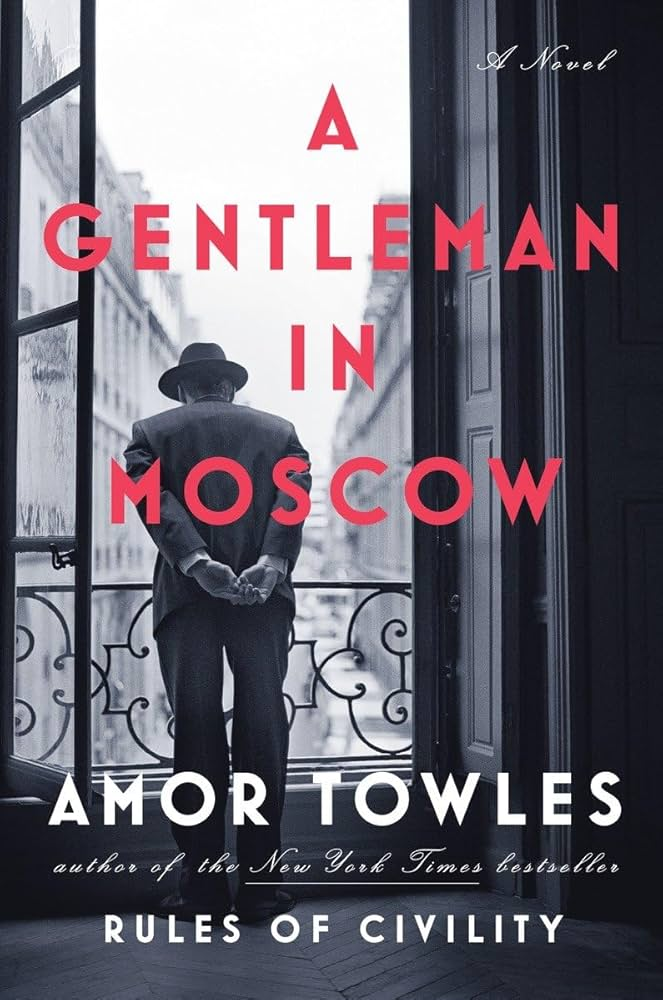
A Gentleman in Moscow

 A Gentleman in Moscow

By Armor Towles

It is 1922, and the Bolsheviks have just defeated the czar. One of their first tasks? Weed out the aristocrats
who had once propped up and benefited from imperial rule. Enter Alexander Rostov -- make that Count Alexander Rostov -- who, appearing before a Bolshevik tribunal, is jovially and stubbornly unrepentant about his station in life. Asked what his job is, for example, he replies, "It is not the business's of gentleman to have jobs." Right. It appears he is heading for the firing squad. But apparently, he penned a revolutionary-minded poem in the early days of the Bolshevik's struggle that had garnered widespread attention and made Rostov something of a hero. Never mind that he didn't actually write it, something the reader finds out well into the book, it is enough to spare Rostov's life. 

Kind of. He is henceforth banished to the Metropol hotel in Moscow, where he had kept rooms as a permanent lodger for some time. It seems a pretty light sentence, given the luxury in which he lived. But then he is forced out of his rooms, where some of his family's antiques remain, and forced into former servants quarters on the abandoned sixth floor. 

For a time, it seems a dreadful sentence, one worse, perhaps, than death. In fact, the Count, after a decade or so, appears ready to reverse the tribunal's benevolence with his own hand. But he doesn't. Instead, he builds a life within the hotel. Most significantly, he befriends a little girl, Nina, who shows him the hotel's secrets and, with it, the secrets of the lives who occupy it. Through Nina, the Count builds real friendships. His escapades for a time nearly always result in his pants splitting, which leads to a friendship with the hotel's seamstress, Nina. He applies his skills as a gentleman to a waiting position at the hotel's fine restaurant, which brings him close to the chef, Emile, and matre d. And, finally, Nina, grown and married, comes to him in a panic many decades into his stay, gives him what proves to be his most meaningful relationship of all: a daughter. Her husband has been sent to a gulag, and she is following. Would he please watch little Sofia and until her return? He has no choice but to say yes. And then, when Nina never returns, to continue to say yes for the rest of his life.

For most of the novel, there is little plot here. We follow the history of the revolution seen from the eyes of one who does not live its harshest results. Though technically confined, Rostov is, as someone points out, the luckiest man in Russia. Along the way, the Count engages in conversations on philosophy and metaphysics. But Towles writes in a snappy way that keeps the reader engrossed, and the Count becomes something of a friend. He is as charming to the reader as he is to his fellow guests. The point/message/moral? Not exactly sure, but perhaps it is something like Thoreau's famous quip, "I have traveled a great deal in Concord." That is, there is far more of interest right under our noses if we only care to look.

The book changes tenor in its final chapters, though, as Sophia gains notoriety as a talented pianist and the Count plans a daring Paris escape to the American embassy for her. Where the count ends up, though, is something of a mystery. He leaves the hotel, we know that. But the final scene has him back in his hometown outside St. Petersburg. Has he become a "free" man? 

Monday, December 9, 2024

My Brilliant Friend

 My Brilliant Friend

By Elena Ferrante

Been having a bit of a hard time finding books that engross me the way I need them to this time of year, so I


turned to the New York Times and its list of the "100 Greatest Novels of the 21st Century So Far" for help. This book topped the list, and its praised all sorts of other places, so I thought I'd give it a shot.

It's essentially a coming-of-age story set in Naples, Italy, a decade or so after the end of World War II. There are two main characters, Linu and Lila, whose lives and identities become intertwined. The friendship has a strange start with Lila throwing Linu's beloved doll down what is essentially a sewer drain and Linu reciprocating. Both girls are distraught and forge a bond in their feelings and in their shared adventurous attempt to rescue the toys. 

The girls become inseparable, but, over time, their lives start to diverge as both seek different pathways to a life outside of their small, stultifying, and sometimes violent neighborhood within Naples. Linu is the first to physically leave, securing a spot at a high school near the downtown after earning high marks in middle school. Her first trip outside the neighborhood is eye-opening -- there is a whole world out there, even in the same city she lives in! This option isn't open to Lila, though, yet for a time she attempts to keep up with her friend's learning. School had always come quickly to her, and she used books from the local library to study Latin and Greek, even going so far as tutoring Linu to help her earn high marks. After a while, though, her intellectual powers find another outlet -- shoes. Her father works to repair shoes, and she designs several pairs. She and her brother work tirelessly for a time to make them a reality, only to have their father reject the effort outright. 

And so, Lila finds herself with basically only one option for a better life: men. Or boys, really. She has an energy and beauty that attracts the neighborhood elite, and becomes betrothed at just 16 to a local grocer who is perhaps the richest man in town. The book ends as her wedding-day luncheon winds down. To all outside observers, it seems as though she has made it. She has found a financial security, even wealth, that most in the neighborhood can only dream of. It has Linu questioning herself. What is the point, she thinks, of all her studying? Where will it lead except to a life as a wife in her neighborhood -- albeit one where she can speak perfect Italian? 

Which brings up one of the central questions of the book: Who, really, is the "brilliant" friend? Whose choices and cunning are the "right" ones, the ones that will lead to a better life as a woman in this male-, and class-centered society? It's a question that is left unanswered as the book ends abruptly. There are two more that follow. I'm not yet sure if I'll seek out the answer.