Sunday, February 25, 2018

The Hearts of Men


The Hearts of Men by Nickolas Butler
This book follows two young boy scouts and their progeny from the early 1960s until today. The first, known as bugler because his job is to sound reveille for the camp every morning, is, in the opening scenes, ruthlessly bullied for his insistence on following the rules. The other seems to walk the line between sincerity and obfuscation, kindness and cruelty, friendship and exploitation. There is little plot to speak of, save the passing of time and events that reveal who these two men really are. But that was enough to draw me in. The author really brought these characters to life for me; even in the first few pages, I felt like I knew them and the internal struggles they were facing. Like a lot of books I've read lately, though, the ending felt a bit...blah. It seems like wrapping up a story is the hardest part of telling it.


Image result for the hearts of men

Monday, January 22, 2018

Bread and Roses, Too

Bread and Roses, Too by Katherine Paterson

I must say that I was disappointed by this book. It's about the "Bread and Roses" strike at the Lawrence, Mass., textile mills in the early 20th century. It should be an inspirational story, but this book make it so bland and cliched. We never really learn what it was like to work in the mills. The characters are all caricatures. And the ending is so darn neat and tidy. Lame.

You Don't Have to Say You Love Me

You Don't Have to Say You Love Me by Sherman Alexie

Is there any author better than Sherman Alexie? I'm totally enamored with his prose and poetry. I'll read
anything by him -- and love it. This book was no exception. It focuses on his troubled relationship with his mother, a reformed alcoholic and unrepentant liar who showed Alexie little love and yet gave him the tools to leave his hardscrabble existence on the reservation to strive for something better. Alexie approached his subject from multiple angles: Mother as a mother (not so good); mother as victim (going back centuries; and mother as survivor (a damn good one). It is hard to fathom the damage our government has done to America's indigenous peoples. I don't know why I so enjoy being reminded of that fact. But I think it is important that I am.

The Someday Birds

The Someday Birds by Sally J. Pla

In this book, four children -- an older sister, an eccentric brother, and two younger twins -- travel cross-
country to visit their father, who is undergoing brain surgery after an injury suffered as a journalist in Afghanistan. The "eccentric" brother bonded with his father over birds. His father once created a list of "someday" birds -- those birds that he wanted to see someday -- even if some of them went extinct. He keeps track of his sightings of these creatures as they travel.

I'm a sucker for any book that features birds and birding, so, naturally, I liked this one. In addition, the main character was believable and likable. You were rooting for him and his siblings the whole way. Definitely an entertaining read.

Sunday, December 17, 2017

A Young People's History of the United States

A Young People's History of the United States by Howard Zinn

My reading of Chains and Forge has had me thinking about injustice in our country, and there is no
better book to point out who has suffered, and gained, in our American story than Howard Zinn. His basic premise is that the story of our nation is not the story we've been taught. It's not a story of equality and liberty and community. Instead, it's a story of an elite few manipulating the poor many, giving them small, superficial concessions designed to keep them from revolting against a system that allows them to get richer and richer. It's a story of these elite pitting one impoverished group against another, of racism and prejudice, and, most of all, of injustice. It's a vision of our nation's past that gives one pause when considering our new political order. Even if you don't agree with Zinn's take on history, his argument should make you consider how the current administration might fit into -- or rebut -- his argument. I very much appreciated the way Zinn adapted his book for younger readers, making very complex topics accessible to all. This should be required reading -- as long as students have the opportunity to disagree with him.

Forge

Forge by Laurie Halse Anderson

Forge picks up where Chains leaves off, which Curzon and Isabel in the middle colonies after they fled
New York City,. This book is told from the point of view of Curzon, who accidentally finds himself in a regiment of American troops who hole up at Valley Forge for the winter.

This is another well-told tale. But, as with Chains, what I liked about it most was the fact that it does not participate in the veneration of the so-called patriots that eventually earned our nation its independence. Rather, it takes great pains to point out their hypocrisy, as many of the men who espoused freedom and liberty also held hundreds of people in bondage -- and failed to see that contradiction. At the very least, this book will make you think differently about who in the American revolution should be considered heroes.

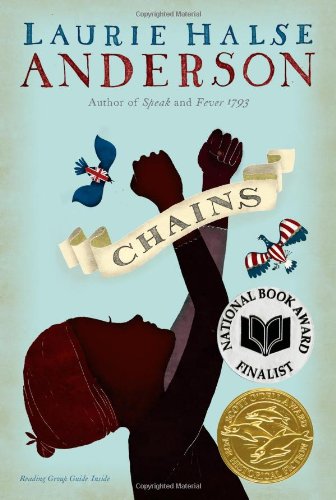
Chains

Chains by Laurie Halse Anderson

Chains tells the story of a young woman caught up in one of our nation's most troubling paradoxes: A
commitment on on the one hand to equality for everyone and a firm belief on the other that people of color are not part of the "everyone" that deserves equality, so much so that we for centuries held them in bondage.

The novel takes place at what could have been a national reckoning of that paradox, but, sadly was not. The main character, Isabel, finds herself sold from a Rhode Island farm to the household of a Tory sympathizer on the eve of the American Revolution. The slave community in New York City, where Isabel finds herself, is split on the question of which group -- the British or American rebels -- would be best for black Americans, and Isabel is forced to put her lot in with one of the groups.

I very much enjoyed this historical piece, for a number of reasons. It was, first and foremost, a lively read. But equally important, it shines a light on a little-known period of American history. We all too often think of slavery as a "southern" issue, when in fact it was at the economic heart of all of the colonies. So too is the political role slavery played in our nascent nation rather underappreciated. When I was in college, I read a book by the scholar Edmund S. Morgan called Slavery and Freedom. It makes the argument that elite whites used racism and increasingly hostile treatment of black slaves as a way to control the white population, whose social and political status rose as the status of the black people around them fell. This book makes that relationship between our unique political system and slavery quite clear and in a way that is accessible to young readers. Well worth the read.