Saturday, August 6, 2022

Black Buck

 Black Buck

By Mateo Askaripour

This novel follows the rise and fall of Darren Vender. At the beginning of the novel, Darren, who


graduated valedictorian from one of New York's most prestigious high schools, is a manager at a Starbucks. Though he is told frequently by those around him -- his mother, girlfriend, friends, neighborhood personalities -- to "make something of himself" he is content to bide his time until an "opportunity" presents itself. And then one day it does. On a whim, Darren makes a sales pitch to a startup executive/coffee shop regular, which leads to a job offer at Sumwum.

Given the environment at Sumwum and what it does to Darren, it is unclear whether the new job represents a rise or a fall. Darren is given a new name, Buck, a nod to his previous employer, and, after passing hell week, embraces the culture of the company whole-heartedly. One by one, his ties to his past are severed. And then his mother dies of cancer that she hid from him for months. In a rock-bottom moment, Buck kicks out a long-time tenant for keeping the details of his mothers' illness a secret. 

And then Buck climbs back up. He begins mentoring other young people of color in the ways of sales as a way to better their lives. Soon it is a movement -- Happy Campers. In the book, all around the world, people of color help each other find and fit into sales jobs. Buck's friends come back. And then figures seeking revenge bring Buck down again. Or do they? He is set up to take the fall for a drug sale and winds up in prison. But he claims to be freer than ever before. 

This book was certainly engrossing, but grating at the same time. I appreciated the author's voice, particularly those moments when he interrupted the narrative to speak directly to the reader, as in, "Reader: Hell hath no fury like a white man scorned. Especially in the world of business. If you're going to do something to piss them off, be prepared for them to strike back sooner or later." But the ups and downs of the book were so predictable, it was like watching a slow-motion car crash. You knew trouble was only a page away. It made me anxious to read. I know it was satire, but it was also pretty fantastical. Satire only really works when it is grounded in reality, and I think this book veered a bit too far from it to be real. 

Tuesday, July 26, 2022

The Adventures of a Girl Called Bicycle

 The Adventures of a Girl Called Bicycle

By Christina Uss

There's really only one word to adequately describe this book, and its one I'm a bit loathe to use, but here


goes anyway: charming. I know -- cringe. But hear me out. It's true.

The eponymous girl in question is left at a young age on the steps of a religious order called the Mostly Silent Monks. Their ethos is that it is better to listen than speak, so they have reduced their verbal communication to a mere eight words, the most expressive of which is, supposedly, sandwich. All of this near silence suits Bicycle quite well, which worries her main caregiver, a retired nun named Wanda, because the young woman seems averse to friendships with kids her own age. Her solution: A summer stay at the Friendship Factory, which guarantees -- guarantees! -- three friendships by the end.

The prospect of spending time at such an institution is more than Bicycle can take, so she sets off on a cross-country bicycle trip to the Blessing of the Bikes in San Francisco, where she hopes she can befriend her bicycling hero, a Polish star named Zbig, and prove to Sister Wendy that she does need Friendship Factory. Her journey is filled with adventure. She meets a Civil War ghost named Griffin G. Griffin who decides to haunt her bike and ride back to his hometown in Missouri. She helps a cafe owner develop a business plan, rescues a racehorse from the Kentucky Derby, loses her bike, buys a new technologically advanced bike at an auction, escapes another Friendship Factory, and finally, finally makes it to the Blessing of the Bicycles, where Wanda is, finally, convinced that Bicycle can, indeed, make friends.

So, why charming? It's partly the steadfast earnestness of the narrator. It's also the fact that the author inserts just enough whimsy. The whole ghost-inhabiting-a-bike thing could be borderline stupid; but she makes it work. Sure, there are parts that are a little over the top -- a scientist studying luck is invited to a fictional country with incessantly bad luck -- but for the most part it all works. And it is so upbeat. Even the downs make you smile. It was just what I needed at this moment.


Monday, July 25, 2022

Hatchet

 Hatchet

By Gary Paulsen

We've been trying to get Kes to read some chapter books without much luck -- Harry Potter was a no-go --


until this one stuck. I'm so glad it did. I'd remembered the story from when I was a kid, and it was great to both share that with him and also to rediscover just what a lovely book it really is. It's not just the plot, which unfolds at a perfect pace, but Paulsen's writing. This really is a literary tale. I love the cadence of Paulsen's sentences, the way he uses repetition and mixes up the length. He's not just trying to get you to read on, he's offering an opportunity to savor the experience. We now have the whole Brian series out from the library. I am looking forward to digging into them all.

Wednesday, July 20, 2022

Nothing to See Here

 Nothing to See Here

By Kevin Wilson

I came across this book after beginning Richard Powers' new book, Bewilderment, which certainly lived


up to its name for the first hundred pages or so. I was bewildered why the author would create a story so sad and, more importantly, why I was still reading it. So I went searching for something more...comical?

Despite Jacqueline Woodson's claim that Nothing to See Here is "laugh-out loud funny" (according to the book jacket), I didn't find it quite that. It was funny more in an absurdist, Phish kind of way. Exhibit A, the premise: A powerful Senator has two children who catch on fire when agitated. That's right, their skin bursts into flames when they are upset. And there is much to be upset about. They were kicked out of the filthy-rich politician's home when they were five, their mother just killed herself and tried to get them to join her, and they've spent the aftermath living with two incompetent grandparents only interested in checks from their father. So -- lots of fire. 

Enter Lillian, the narrator of the book, a longtime "friend" of the kids' stepmother, who is more or less obsessed with getting her new husband the post of Secretary of State so she can have some kind of political platform herself. It becomes Lillian's job to take care of the kids, to keep them from bursting into flames in a public way so that the vetting process can go off without a hitch. Lillian, whose life has amounted to very little -- in no small part because she agreed to take the fall when this step mother was caught with coke at the fancy private school she managed to get herself into -- is an unlikely caregiver. But she sees her weirdness reflected in the two kids, Bessie and Roland, and manages to bond with them.

Lillian's voice is what makes this story work. She has some very interesting turns of phrase. As she readies herself for Bessie to burn, for instance: "‘Roland,’ I said, so quietly, so calm, like I was euthanizing a cat, ‘go get me a towel, O.K.?’” Like she was euthanizing a cat?! What a wonderful comparison. Perhaps this is what made Jacqueline Woodson laugh.

I'll definitely be checking out more of Wilson's work.

Sunday, July 10, 2022

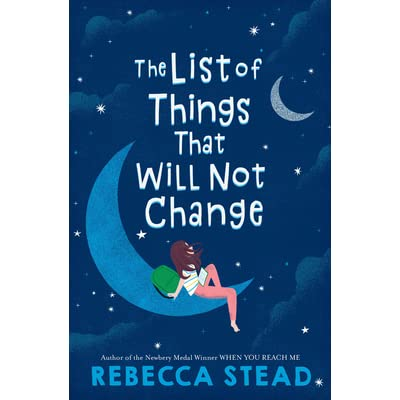
The List of Things that Will Not Change

 The List of Things that Will Not Change

By Rebecca Stead


The list referred to in the title of the book was bestowed on the main character, Bea, when her parents let her know that they were getting divorced. But this is no usual divorce; Bea's dad, it turns out, is gay, and the separation is beyond amicable. To the list her parents started -- they will always love her, etc. -- Bea continues to add as she grows. So the divorce isn't really the conflict that one might think it is. Rather, the conflict is Bea's own internal struggle to accept herself, to control her impulsivity, and to forgive herself for the mistakes she has made. The backdrop to all of this is Bea's dad's wedding to his new partner.

If this all sounds a bit too tidy and even a little cliched -- there is even a scene at the wedding where an estranged cousin causes an anti-gay scene -- it is. But Stead is a great writer who made even this predictable tale engrossing.

Thursday, June 30, 2022

Harlem Shuffle

 Harlem Shuffle

By Colson Whitehead

The central character of Whitehead's latest novel is Ray Carney, and the book tracks his travails over two


decades as he "shuffles" -- maybe hustles is a better world -- between two worlds to make something of himself in 1950s and 1960s Harlem. The most visible, above-board part of this striving is a furniture store. But even that is tainted by the crooked part of his life; Carney opened the store with seed money from his father, a small-time crook who never broke the surface of straight life. Carney's work in New York's illegal life is as a fence, someone who takes stolen goods, mainly jewels, and turns them into cash for himself and the thief. Carney seeks a balance between these two worlds, but it is continually upset by his cousin-cum-brother, Freddie, who thoughtlessly brings Carney in deeper than he wants by connecting him to gangsters and, even worse, straight-seeming gangsters in the form of the powerful Van Wyck -- pronounced Wike, not Wick -- family. 

The book is, in part, an examination of exactly what it means to be crooked. In this version of Harlem in this book (and I have no idea how realistic it is), no one is clean. Not the neighborhood cops, who take money to leave criminal enterprises alone. Not the black elite members of the Dumas Club, the leader of which embezzles money from fellow members. And certainly not the wealthy white families who run the city, whose operations appear more like the mafia than a business.

It is also a story of the city itself and how it changed over time. The years '59, '61, and '64 are very specific, and align with key moments in the city's development. '64 is particularly poignant. It is the year of the World's Fair, of rioting in Harlem, of the growth of the World Trade Center building. From Carney's point of view, it's all a "shuffle", a shell game in which the rich, white elite move the cups in a way that makes you think you're winning, but who always end up adding to their piles of wealth and privilege. 

Whitehead is an incredible author. I don't know how he manages to take on a new voice, a new style with each of his books. This was one of those that made the world he imagined (even if much of it is real) alive for me. I felt like I knew Carney, and am a little sad our stories have now diverged.

Sunday, May 1, 2022

Lovecraft Country

 Lovecraft Country

By Matt Huff

Set in 1950s, Jim Crow America, this genre bending -- or maybe blending is the right term -- follows the


travails of the Turner family as they seek to fend off a heretofore unknown secret society of white sorcerers known as the Order of the Dawn. One member of the Turners, Atticus, is the last known direct-descendant of one of the founders of the order, and this status makes him (or, rather, his blood) a sought-after tool for wizards hoping to advance their skills and standing. Chief among them is Caleb Braithwhite. 

The novel is told in a series of connected but nearly stand-alone stories that borrow from science fiction, pulp, and horror. It starts when Atticus, his father Montrose, uncle George (who happens to publish a travel guide modeled on the Green Book), and cousin Letitia are lured to a New England village at the heart of the order's power. Other adventures ensue: Letitia buys a house haunted by a one-time rival of Caleb's father; Atticus' aunt, Hippolyta, enters a machine that takes her to another planet; his nephew, Horace, is "marked" so that he animates statues around him, giving them murderous intentions; another aunt is given an elixir that, for a few hours at a time, turns her skin white. 

In the end, the Turners manage to remove Caleb from their life -- for the moment. The central theme of the book is revealed as Caleb Braithwhite stands on the side of the road, his powers stripped, begging the Turners to reconsider his punishment. He warns them that other members of the order are aware of Atticus, "And they'll be coming for you...they won't leave you alone until they get what they want from you. No matter where you go, you'll never be safe..." The Turners just laugh. Atticus responds: "What is it you're trying to scare me with? You think I don't know what country I live in? I know. We all do." In other words, whiteness itself is a kind of secret society, and the "horrors" Braithwhite brought into the Turners lives is no match for the real-world horror of Jim Crow.

Loved this book. It was just suspenseful enough to keep the pages turning but humorous/pulpy enough to keep it at bay. I read it in less than a week -- no small feat with school in session. It is now the basis for an HBO series, and I wonder how the tone of the live-action version matches the book.