Wednesday, March 22, 2023

Signal Fires

 Signal Fires

By Dani Shapiro

This was the second of my father's annual Valentine's Day book gift. Perhaps I'm projecting here, but it


seems like a major theme of the book is finding peace during middle age. The main characters of this novel have a harder time than most. In the opening scene, two of the main characters, brother-and-sister duo Theo and Sarah, are in a car that crashes and kills a friend. Inexplicably, the family decides to never speak of the incident again, leaving the trauma to fester for decades. It manifests itself in unproductive ways. Sarah turns to alcohol, Theo up and leaves the country without telling anyone, and Mimi, the mom, develops early-onset Alzheimers. They are all eventually saved, if that is the right word for it, when their story intertwines with new neighbors across the street, the youngest of which, Waldo, is a precocious 10-year-old with a genius level IQ and an obsession with stars, the "signal fires" of the title. 

Waldo's ruminations on stars and the atoms that make them up point toward another theme: the connection between all things. We are, after all, as CSNY pointed out, star dust. Waldo continually reminds us that everything is connected, and, at times, is even able to see the past, present, and future all mixed up at once. This is what happens when he, by chance, is with Mimi when she passes away. It's an idea emphasized by the organization of the novel, which jumps back and forth in time, and includes heavy doses of foreshadowing in the sections on the past.

In this sense, the author seems to be making a claim -- or maybe grasping at? -- of immortality, that we never really die. While I found the story engaging and very well written, it is the heavy-handed way in which the author presents this idea that will make this book forgettable. It seems more like an attempt to comfort herself than an actual story; judging by the book jacket, Dani Shapiro is also in middle age and, one would suspect, grappling with questions of mortality. In her book, everything ends happily -- even death! -- and all loose ends are tied up. I wish the book had sought to raise questions more than provide answers.

Tuesday, March 7, 2023

Trust

 Trust

By Hernan Diaz

The title of this novel is a play on the two themes explored throughout. On the one hand, it is a reference


to money, apt considering the book revolves around the rise of a financier who predicts the stock market plunge of 1929 and winds up unimaginably wealthy. Perhaps more interestingly, though, it refers to the ways in which reality often conforms to the person who owns its narrative. As the financier in question, Andrew Bevel, tells his secretary-cum-ghost-writer: "My job is about being right. Always. If I'm ever wrong, I must make use of all my means and resources to bend and align reality according to my mistake so that it ceases to be a mistake." And as the father of ghost-writer Ida Perenza claims, "History itself is just a fiction -- a fiction with an army. And reality? Reality is a fiction with an unlimited budget. That's what it is. And how is reality funded? With yet another fiction: money. Money at the core of it all. An illusion we've all agreed to support. Unanimously."

As if to prove this point, Diaz starts the novel with a novel-within-a-novel called Bonds, which tells the story of a Bevel-like financier, his rise to enormous wealth, and the mental decline that ultimately results in the death of his wife. I was fully prepared for the next section of the book to pick up where the last left off. Instead the reader is given My Life by Andrew Bevel, which is confusing, not only because it is unfinished, but also because much of it seems to echo Bonds. The two are connected in the third portion of the book, in which Ida looks back at her time working for Bevel. Turns out, Bevel's autobiography is a response to Bonds, which he found inaccurate and appalling. And it is at this point that I caught on to what the author was doing -- 193 pages in. I felt a little foolish until I read this review on NPR, the author of which felt similarly. Then there is the final section of the book, transcribed diaries of Bevel's wife that call into question who was responsible for the Bevel fortune. The diaries seem to claim it was she who developed the investing strategy that led to the wealth. Then again, she writes them in the days before succumbing to cancer, when she is regularly on morphine.

So, who to "trust"? I don't know, but I do know this was an engrossing read. After reading part one of the novel, I was beginning to wonder why the book had been long listed for the Booker Prize. But the narrative shifts made it clear. It is the rare book that keeps you engaged in the plot while also raising thought-provoking questions along the way.

Saturday, February 18, 2023

Shutter

 Shutter

By Ramona Emerson

This is one of the first books I've purchased in a while. I did so after hearing an interview with the author


on Fresh Air. It sounded like nothing I'd read in a long time. After I bought it, I sat on it for a long time. It's a thin novel, and I guess I was enjoying the anticipation of the story. When I did crack the pages, I wasn't disappointed.

The book is the story of Rita Todacheene, who works as a forensic photographer in Albuquerque, NM. She's had a fascination with cameras and photography since she was young. Dead people, too. It turns out she was able to see them when others couldn't. It is/was at once a gift and an affliction; it allowed her to connect with her dead grandfather; but other spirits had come to her demanding justice. That was the case when Rita showed up to document a particularly grisly death that involved a woman falling from an overpass before being smashed to bits by unsuspecting cars below. It was ruled a suicide, but the woman in question shows up in Rita's life and is quite insistent that it was murder. She won't let Rita rest until the truth is unraveled.

This book had it all. It was funny in parts, suspenseful in others. It kept me rapt and it was done all too soon -- just as I suspected.

Hard Boiled Wonderland at the End of the World

 Hard Boiled Wonderland and the End of the World

By Haruki Murakami

January means Murakami! I'm to the point where I need to dig a little bit to find books of his that I haven't


read. 

This novel takes place in what appears at first to be two different locations. The first is a futuristic Japan in which two groups, the System and the Semiotics, are in a kind of battle over information. Our main character is a "calcutec" who works for the government-backed system. His expertise is "shuffling" data, which I think is meant to be a form of encryption designed to keep it safe from the thieving Semiotics. One day this Murakami man -- kind of ho hum, divorced, aimless -- is summoned to do some shuffling for a mad-scientist type who lives and works in an underground layer. His work there captures the attention of the Semiotics, who bust into his apartment and knife him in the stomach, which sets off a trip back to the underground to rescue the mad scientist -- and figure out what the hell is going on.

This story alternates with another tale, this one set in a vague, mystical Town described as "the end of the world." Here "beasts" (unicorns) roam in and out of the town's walls, everyone is assigned a job by a gruff gatekeeper, and everything is a facsimile of the "real" world. Our Murikami man is newly arrived in this town. He is assigned the job of "dreamreader"; every evening, he goes to a library stocked with the skulls of the beasts, which glow with memories if he concentrates hard enough. Things are peaceful and calm, but, of course, there is a catch: Murikami man was separated from his shadow upon entry to his town and, with the onset of winter, the shadow isn't doing well. If it dies, the man will lose his "mind" -- that is, his ability to think for himself and of himself as an individual. The shadow devises an escape plan, which the man seeks to execute in the novel's final pages.

The two stories converge when we learn that this "end of the world" is really a figment of the real-world Murikami man's subconscious, in which he is doomed to be stuck because of the operation that allowed him to "shuffle", a task that requires the disassociation of the left and right brains. He learns from the scientist that he has about 25 hours left before he is stuck inside this mental creation for eternity. The escape from the Town that takes place in the alternating chapters suggests that there is hope he can avoid this fate. But, at the last moment, the man decides to save his shadow but nevertheless remain in the Town. He thinks he can both retain his "mind" and stay in his made-up world. 

It all seems like a meditation on the nature of consciousness. To what extent can we, and do we, live in a world of our own mental making? How do our subconscious thoughts and make up express themselves in our everyday life? Who really controls us -- are we hardwired from the beginning or do we have real choices? Does consciousness die when we do? 

These are all questions that Murakami explores in his other novels as well. I just read that this book is supposedly one of Murakami's favorites, though I wouldn't put it in that place. I guess the science fiction components felt less mystical than his other books and more scientific. There is one chapter in which the scientist explains "shuffling" that really lost me. Still, the action picks up toward the end, and I really appreciated, though am a bit haunted by, the twist at the end. Till next January, Haruki!

Saturday, December 31, 2022

How the Light Gets In

How the Light Gets In
By Louise Penny

Thought I'd end 2022 with a return to Louise Penny's page-turning Armand Gamache detective series.
This one is set at just about Christmas time, to boot.

There are three conflicts going on in this one. The event that brings Gamache back to Three Pines is the murder of Constance Ouellett, a member of the once-famous Ouelett Quints -- the first documented case of a successful quintuplet birth in the world. Raised in the public eye by the government. Constance and her sisters retreated to privacy in their last years. But Constance could not retreat from the trauma of her past, and had taken to seeing a therapist in Montreal. This turns out to be Myrna, the bookshop owner of Three Pines. Constance visited her old therapist/friend in Three Pines in December, with plans to return for Christmas. When she doesn't, Gamache returns to the village.

He brings with him some baggage of his own. His once-right-hand-man, Jean-Guy Beauvoir, is not with him. Instead, he's been transferred out of the Surete homicide division -- and, after a divorce from his daughter Annie following a return to addiction (Oxycontin), Gamache's life. Almost. Gamache is there in the wings, doing a little more than hoping for Beauvoir's recovery and return.

And then there's the "grand scheme", a plot by the head of the Surete and, it turns out, the minister of Quebec. It takes most of the book to learn what this scheme is; Penny is pretty heavy-handed on the foreshadowing and suspense. But it turns out that the two have for years failed to perform basic repairs and upkeep on Quebec's infrastructure, pushing it toward failure in the hopes they can pin the ensuing disaster on the Canadian government and ride a tide of independence fever to more power than they already have. The pair know that Gamache is working to foil them, and they are the ones responsible for the gutting of Gamache's department -- and Beauvoir's additction.

Gamache, though, has some aces up his sleep, too. And, once again, he outsmarts and outworks his opponents to victory. Don't think that's much of a spoiler. 

If mac'n'cheese is comfort food, the Gamache series is a comfort book. What fun to return to Three Pines and its cast of close-knit characters. Till next time... 

Wednesday, November 30, 2022

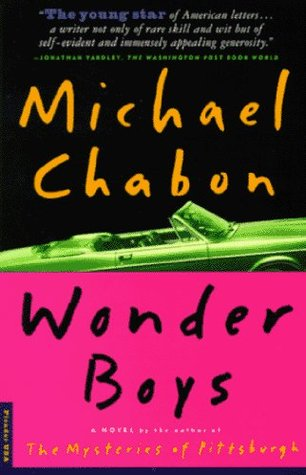
Wonder Boys

 Wonder Boys

By Michael Chabon

Wonder Boys was one of my favorite movies in my late teens and early 20s. It features Toby MaGuire,
Francis McDormand, Robert Downey Jr. and Michael Douglas. I'd always known it was based on a book, and came across it one day while visiting the library with some students and thought I'd check it out to see how well it conformed to the book.

It turns out, Wonder Boys is an ideal example of what people mean when they say a book is "cinematic". From what I could tell, the screenwriters of the movie barely had to change a thing. The dialogue, the scenes, the setting -- it was all there in the book. It was, in fact, just like watching the movie again. There were, of course, small differences. Grady Tripp's physique -- he's no small, svelte Michael Douglas in the book -- is one. We also learn much more about Grady's future-former wife, Emily, who, it turns out, is adopted, from Korea, into a Jewish family that moved full time out into the Pennsylvania countryside after the patriarch's retirement. 

I do wish I'd come across Chabon's book first. I think I would have liked it a lot. And it would have allowed me to create pictures of the characters in my head. As it was, all I could picture were Michael Douglas, Robert Downey Jr., Frances McDormand, and Toby MaGuire. All well. I need to read more Michael Chabon.

Wednesday, November 23, 2022

The Last Revival of Opal and Nev

 The Last Revival of Opal and Nev

By Dawnie Walton

This is the story of an interracial rock duo from the 1970s -- as well as the magazine-editor working to tell


their intertwined story. Nev is a British songwriter trying to find an electrifying partner when he stumbles upon Opal in a Detroit nightclub. It is Opal's sister who has the voice, but she who has the panache of a star. The two put out a record that is destined for obscurity until one night when their record label puts on a showcase of its talent headlined by their one hit-maker, the Bond Brothers. This southern-rock band attracts an audience of Hell's Angel-like bikers who are obscene and loud -- and riotous when Opal, who has been eyeing warily the Confederate flag the Bonds like to use as a prop at their show, reveals that she has stolen it and gathered it around her like a diaper. A picture of a wounded Nev hauling an even more wounded Opal out of the theater makes a splash in the Times and Opal and Nev ride the attention to a new record, fame, and a small fortune.

Oh, and the drummer for the band, Jimmy Curtis, is killed in the melee. He happens to be the father of the editor/reporter hoping to tell Opal and Nev's story ahead of a reunion tour, LenaSarah "Sunny" Curtis. The book switches back and forth between interviews with Opal and Nev, Sunny's narrative, and other bits of media, all of which are designed to make the book read like the "real" thing; there are even footnotes. In her research, Sunny interviews the sole surviving Bond brother, who claims it was Nev who told his drugged up former self that Opal had stolen his stars and bars and started the riot that night. It's a fact that has the potential to blow the Opal and Nev reunion tour up -- if anyone believes it. It also provides a window into an exploration of the role that race and gender play in the music industry (and world as a whole). 

All in all, I found this to be an engrossing book. I wonder, though, whether its realism adds to it or detracts from it. The series of events are so tied to real events that it sometimes felt tedious to re-read them. I was certainly ready for it to be done when it was over.