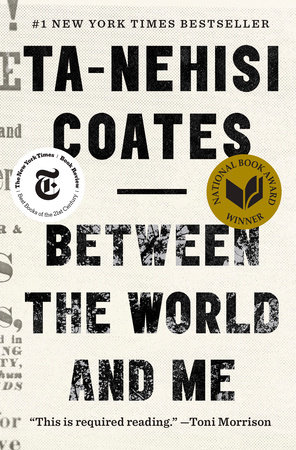
Between the World and Me
By Ta-Nahesi Coates
Why I just picked this book up, some five years after it was first published, is something of a mystery to me. I can recall holding a copy back then, but somehow not finishing it. Perhaps police brutality of that moment didn't strike me as unjust enough? I'd like to think not, but I find it a bit shameful now. This book is nothing if not eminently readable. You could miss the message entirely and still be enthralled by the sentence construction and turns of phrase.
About that message...that, too, remains a bit of a mystery. It actually had me looking up reviews of the book. This is not the five paragraph essay with a clear claim, evidence, and reasoning that I teach my students. It is far more meandering, weaving in and out of outrage, reflection, advice, anecdote, and hope. A little less than 12 hours after finishing the book, what my mind keeps coming back to is the way Coates continually tries to puncture our nation's fundamental myth: The American Dream.
It is true that all nation-states are founded on myth. This method of political organization is relatively new to humankind, whose traditional bonds were based on shared language, customs, religion, and, perhaps most importantly, kinship. The nation-state seeks to rise above these commonalities, to convince people to see others' whose tongue, traditions, and family tree are different than their own as countrymen. We often think of this as a uniquely American problem -- exceptionalism is a cornerstone of our myth -- but it is not. One need look no further than Ireland, where culture and religion keep an island divided -- to see that this challenge is both universal and modern. How to overcome it? Laws? Democracy? Representation? Stories.
Though the story we Americans tell ourselves is multi-faceted, at its heart is the idea that our nation, our land, is one of opportunity, that with enough effort you, too, can own a beautiful, safe suburban home surrounded by manicured lawns and protected by a just-menacing-enough white picket fence. This story glosses over a lot -- particularly the fact that not only is this "opportunity" has not, and largely is not, open to those whose skin happens to be dark but that it was, and continues to be, built on the violent exploitation of those same people. Girding this myth is another: That people with different colored skin belong to different "races".
I think it is fairly easy for people to recognize and criticize the version of the American Dream I describe above. But the second myth, which is part and parcel of the first, is much harder to wrap one's head around. Race is ingrained in our national consciousness. But it is a work of fiction. It is a story we tell ourselves -- and believe. It is not simply a matter of labeling others. It is also a matter of how we see ourselves. Coates continually refers to "those who think they are white." In defining ourselves this way, we perpetuate the myth and the exploitative system it supports.
Another point of the book, I think, is to show what it looks like to go through this system as a member of this exploited group. Coates talks about the need to understand slavery not as a "mass of flesh" but as a single person as intelligent and feeling and curious as we are. By sharing his story, he helps do the same for contemporary America. He speaks of an incident in New York City in which a white woman pushed his son out of the way in a crowd; when confronted, several white onlookers come to her aid and remind Coates that they could have him arrested. It is a tiny moment, but one that underscores for Coates and for the reader the way in which our society robs people of color of their bodies.
So what to do? Clearly, Coates' book, written in the form of a letter to his 15-year-old son, is not directed at a white audience. Nor should it be. His advice to his son is to continue the struggle, to question the world around him and the myths that pervade it. But he is quick to point out that while one person can make a difference of some sort, the idea that a single human can change a society is itself a myth. Coates points out that the moments of progress in the past have coincided with other major upheavals: the Revolutionary War, the Civil War, World War II, etc. And now we face another upheaval in the form of a pandemic. Could this be another moment of real progress?
And what might my role be in this? I feel like I understand the big idea here. I know, intellectually, that race is a myth created to allow people whose skin looks like mine to exploit people whose skin is darker than mine. And that this is continuing to happen. And that I have benefited, and continue to benefit, from this system. But now what? March? Teach? Speak? Think? Read? Question? I don't know.