Monday, October 12, 2020

Dig.

 Dig. by A.S. King

It's been a while since I've finished a book. I started and abandoned several in late summer and fall. I


finished this one. So that says something about it. 

Truth be told, I picked up the book because it won a Printz award; I couldn't resist the shiny medal on the front cover. The book tells the story of a family that is, at best, dysfunctional. The title is partly a reference to the origins of the fortune enjoyed by the heads of the family, Marla and Gottfied, the latter of which tricked his family into selling off their potato farm so he could cash in on the property. It is also a reference to the many teenage voices in the novel, each of whom is seeking to learn about their past. It is, I think, a commentary on generational trauma and the difficulties of breaking free from parents' mistakes and mistaken beliefs.

I did finish it. But I can't say I thought it was all that great. Marla and Gottfied are made out to be awful human beings. We learn that they kicked children out of the house when they became pregnant, and refuse to provide financial assistance to their kids despite $10 million in their bank accounts. But the way they interact with others in the present doesn't seem to match these horrors. Their present selves don't seem to match their reported past selves. In addition, the author seems to just lob in the fact that some of the characters are dealing with and, to varying degrees, confronting racism. But this seems like something thrown in to make the story more relevant. In the end, I think the author failed to create a world the reader could truly inhabit. The characters and their lives are a little too obviously made up.

Wednesday, August 5, 2020

Whiskey When We're Dry

Whiskey When We're Dry 
By John Larison

What a perfect companion to my recent trip to Wyoming. All I wanted was something to get lost in and, preferable, a yarn that would illuminate the landscape before me. This book gave me all that and more.

The story tells the tale of Jessilyn Harney, who finds herself alone on a western ranch after her brother leaves their distant father and that patriarch dies in a horse-riding accident. Not adept in the traditional ways of femininity, Jessilyn is unable to quickly procure a husband. And so she becomes a he -- Jesse -- and sets out to find her brother in the hopes of bringing him back to the ranch and bringing it back into good standing.

Only problem is big brother, Noah, is an outlaw with quite a bounty on his head. The governor has raised a militia to find and destroy him. So, naturally, Jesse parlays his talents with firearms into a position with the governor's guard, which, in spectacular fashion, ends up in a reunification with his brother.

All the tropes of a western are here: guns, outlaws, whiskey, underdogs, sagebrush. The twist, of course, is the way the main character defies the gender stereotypes of the time. Truth be told, this would be an engrossing read without that innovation. This is a tale well told. I'm not sure that the new layer adds up to anything profound. But I sure would read it again.

Whiskey When We're Dry by John Larison – P.K. Adams

Monday, July 13, 2020

Bel Canto

Bel Canto by Anne Patchett

Bel Canto (novel) - Wikipedia

Picked this one up in March, and writing about it in July...

I'd heard Maureen Corrigan review an Anne Patchett book by beginning,"I'm always excited when a new Anne Patchett book comes out" -- or some such thing -- and since I love Maureen Corrigan and had never read any Anne Patchett, I thought I would check her out. The library didn't have the latest that Corrigan was reviewing, but Bel Canto turned out to be a great intro to the quarantine.

The book tells the story of an executive of a Japanese-based technology company, which in my mind was something like Sony. He happens to be a lover of opera, and, in the hopes of convincing his company to open a plant in their nation, the government of an unnamed South American company  lures him to their capital city for a birthday party featuring his favorite singer. Not long into her performance, though, the venue is overtaken by guerrillas hoping to take the president, who is not actually present, hostage and gain the release of their compatriots. And for the next several months, the entire party, made up of figures from around the world and of all stations of life, are bound together.

In the end, this troupe, including the hostage takers, become a community, bound together by what becomes a shared appreciation for opera. The message seems to be that art can bring us together -- if only we had the time to truly listen/watch/take it in.

The book certainly sent me into the quarantine with high hopes and lofty goals. Not sure I've met them -- yet. Perhaps I need a few more months?

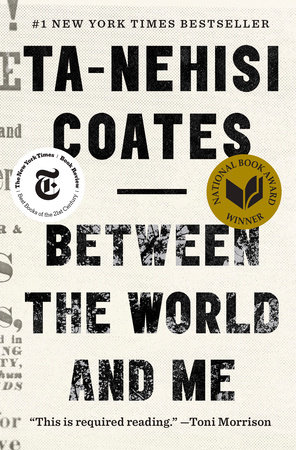
Between the World and Me

Between the World and Me 
By Ta-Nahesi Coates

Between the World and Me by Ta-Nehisi Coates: 9780812993547 ...

Why I just picked this book up, some five years after it was first published, is something of a mystery to me. I can recall holding a copy back then, but somehow not finishing it. Perhaps police brutality of that moment didn't strike me as unjust enough? I'd like to think not, but I find it a bit shameful now. This book is nothing if not eminently readable. You could miss the message entirely and still be enthralled by the sentence construction and turns of phrase. 

About that message...that, too, remains a bit of a mystery. It actually had me looking up reviews of the book. This is not the five paragraph essay with a clear claim, evidence, and reasoning that I teach my students. It is far more meandering, weaving in and out of outrage, reflection, advice, anecdote, and hope. A little less than 12 hours after finishing the book, what my mind keeps coming back to is the way Coates continually tries to puncture our nation's fundamental myth: The American Dream.

It is true that all nation-states are founded on myth. This method of political organization is relatively new to humankind, whose traditional bonds were based on shared language, customs, religion, and, perhaps most importantly, kinship. The nation-state seeks to rise above these commonalities, to convince people to see others' whose tongue, traditions, and family tree are different than their own as countrymen. We often think of this as a uniquely American problem -- exceptionalism is a cornerstone of our myth -- but it is not. One need look no further than Ireland, where culture and religion keep an island divided -- to see that this challenge is both universal and modern. How to overcome it? Laws? Democracy? Representation? Stories.

Though the story we Americans tell ourselves is multi-faceted, at its heart is the idea that our nation, our land, is one of opportunity, that with enough effort you, too, can own a beautiful, safe suburban home surrounded by manicured lawns and protected by a just-menacing-enough white picket fence. This story glosses over a lot -- particularly the fact that not only is this "opportunity" has not, and largely is not, open to those whose skin happens to be dark but that it was, and continues to be, built on the violent exploitation of those same people. Girding this myth is another: That people with different colored skin belong to different "races".

I think it is fairly easy for people to recognize and criticize the version of the American Dream I describe above. But the second myth, which is part and parcel of the first, is much harder to wrap one's head around. Race is ingrained in our national consciousness. But it is a work of fiction. It is a story we tell ourselves -- and believe. It is not simply a matter of labeling others. It is also a matter of how we see ourselves. Coates continually refers to "those who think they are white." In defining ourselves this way, we perpetuate the myth and the exploitative system it supports.

Another point of the book, I think, is to show what it looks like to go through this system as a member of this exploited group. Coates talks about the need to understand slavery not as a "mass of flesh" but as a single person as intelligent and feeling and curious as we are. By sharing his story, he helps do the same for contemporary America. He speaks of an incident in New York City in which a white woman pushed his son out of the way in a crowd; when confronted, several white onlookers come to her aid and remind Coates that they could have him arrested. It is a tiny moment, but one that underscores for Coates and for the reader the way in which our society robs people of color of their bodies.

So what to do? Clearly, Coates' book, written in the form of a letter to his 15-year-old son, is not directed at a white audience. Nor should it be. His advice to his son is to continue the struggle, to question the world around him and the myths that pervade it. But he is quick to point out that while one person can make a difference of some sort, the idea that a single human can change a society is itself a myth. Coates points out that the moments of progress in the past have coincided with other major upheavals: the Revolutionary War, the Civil War, World War II, etc. And now we face another upheaval in the form of a pandemic. Could this be another moment of real progress? 

And what might my role be in this? I feel like I understand the big idea here. I know, intellectually, that race is a myth created to allow people whose skin looks like mine to exploit people whose skin is darker than mine. And that this is continuing to happen. And that I have benefited, and continue to benefit, from this system. But now what? March? Teach? Speak? Think? Read? Question? I don't know.

Friday, July 3, 2020

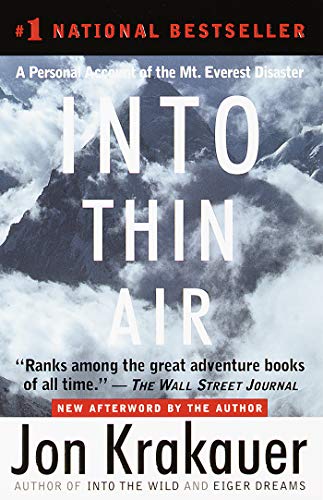
Into Thin Air

Amazon.com: Into Thin Air eBook: Krakauer, Jon: Kindle Store


Into Thin Air
 by Jon Krakauer

I came into this book a little prejudiced. The only other Krakauer book I'd read was Into the Wild, and it didn't leave me with a very favorable impression of the author. Though the story he told was told well, I was put off by how self-referential the book seemed; it was almost as if Krakauer was using Chris McCandless' story as a vehicle to talk about himself. 

This was a different book entirely. It was focused almost solely on Krakauer -- but for good reason. It was an account of his trip to Mt. Everest in the '90s on an expedition that claimed the lives of many climbers, both expert and novice. The author's voice here verges on humble. He enumerates his shortcomings and doesn't shy away from his mistakes. For example, for months after the accidents on the mountain, he had asserted that he'd seen one missing climber very near base camp. However, he realized later that he had been mistaken, that his memories of the day were clouded by exhaustion and altitude sickness. The error gave one family false hope and another unnecessary grief, and both reacted with anger. Krakauer includes their criticisms and owns up to his mistake. He even acknowledges the problematic nature of writing about and making money on the stories of others' deaths. In my mind, he comes off as balanced and fair in taking on these issues.

I was inspired to read the book after offering it as a book group option in a Wilderness Studies class I taught last year. The overarching question was, How does this book help us better understand the concept of wilderness. There is a lot in here that gets at that question. On the one hand, Everest is highly commercialized. Teams of guides chart tens of thousands of dollars to take climbers up the mountain, where their nearly every need is taken care of. All most climbers have to do is step where their guide tells them to step. They aren't making decisions or even carrying their own gear. At the same time, the storm described in the book demonstrated that nature remains firmly in charge on the mountain. Man is clearly a visitor here -- even if we forget it sometimes. No amount of training or preparation can eliminate the risks associated with climbing Everest. In that sense, I think it remains a wilderness, albeit one diminished by man's presence. 

Saturday, June 27, 2020

The Night Watchman


 The Night Watchman - Kindle edition by Erdrich, Louise. Literature ...
The Night Watchman by Louise Erdrich

This books takes as its backdrop a movement in the 1950s to "emancipate" Native Americans by terminating tribes' recognition as such by the federal government. The idea, according to its proponents was that this status had made indigenous peoples dependent upon the federal government and therefore held them back from their full economic potential. Of course, behind the scenes was a more dubious intent -- it was an opportunity, if successful, to wrest valuable lands away from Native Americans and put them in the hands of whites. It strikes me that this is another example of economic profiteers beginning with greed and then working backwards to come up with a justification; recently, many have pointed out that the same thing happened with racism. It's not that whites enslaved black Africans because they were racist, at least not at first. Rather, they enslaved black Africans because they wanted freed labor. Then, understanding, it seems, that enslaving another human being for personal gain is a bit...unrefined(?), they went through a lot of trouble mining the Bible, Greek philosophy, and pseudo-science to develop and spread the idea that people of African descent were inferior to whites. Racism. Basically, the white establishment has been terribly effective at enriching themselves economically, socially, and politically at the expense of the "other."

As Erdrich tells it, Mormon views on Native Americans evolved in the same way. Mormons apparently believe that Native Americans were one of four ancient groups who settled in the Americas; they are called the Lamanites in the Book of Mormon. The Lamanites were not a good people, and it was the job of the so-called Latter-Day Saints to bring them back to the Lord. I might be getting that wrong, but Erdrich through her characters seems to be indicating that this belief system ingrained the idea of Native American inferiority in the Mormon church, which encouraged its congregations to take land from indigenous peoples. It just so happens that the architect of tribal termination was a Mormon whose family's wealth came from their accrual of formerly Native lands. 

I will say that this part of history is a rather small part of the book. It is always in the background, but that is where it mainly stays. That disappointed me. I had heard Erdrich speak about termination on Fresh Air, and was fascinated by this here-to-fore unknown part of our past. I thought it would play a more prominent role. What Erdrich does really well, though, is bring the Turtle Mountain Tribe reservation of the 1950s to life. She makes you feel with the characters in a way that draws you into the story -- even if the plot is rather thin.

Tuesday, March 10, 2020

The Girl with the Louding Voice


Image result for the girl with the louding voice

The Girl with the Louding Voice by Abi Dare

I wanted to like this book. It tells the story of a young woman named Adunni, whose story begins in a small village in Nigeria. Though her plight begins before the narrative begins with the death of her mother, it worsens at the beginning of the novel when she is married, against her will, to a local man who has promised to pay her fathers' rent in exchange for Adunni. It is the first of Adunni's captivities, for no sooner does she escape the home of her new husband than she finds herself the maid of a tyrannical woman in the city of Lagos. She receives no pay for her work beyond the daily beatings she receives on behalf of her new employer. Nevertheless, through it all, Adunni remains hopeful and, in the end, is rewarded with a new life.

Obviously, the subject matter is important. It is a story of neo-slavery that hasn't been told much in the west. But the ending was evident from the beginning. From the moment Adunni learns of a possible scholarship for domestic servants, it is obvious that she will get it. But it takes the author more than a hundred pages for that inevitability to become a reality. In the meantime, the other events of the story don't offer much insight into the character or much in the way of suspense. For me, that left it a slog that I was happy to finish.