Thursday, June 30, 2022

Harlem Shuffle

 Harlem Shuffle

By Colson Whitehead

The central character of Whitehead's latest novel is Ray Carney, and the book tracks his travails over two


decades as he "shuffles" -- maybe hustles is a better world -- between two worlds to make something of himself in 1950s and 1960s Harlem. The most visible, above-board part of this striving is a furniture store. But even that is tainted by the crooked part of his life; Carney opened the store with seed money from his father, a small-time crook who never broke the surface of straight life. Carney's work in New York's illegal life is as a fence, someone who takes stolen goods, mainly jewels, and turns them into cash for himself and the thief. Carney seeks a balance between these two worlds, but it is continually upset by his cousin-cum-brother, Freddie, who thoughtlessly brings Carney in deeper than he wants by connecting him to gangsters and, even worse, straight-seeming gangsters in the form of the powerful Van Wyck -- pronounced Wike, not Wick -- family. 

The book is, in part, an examination of exactly what it means to be crooked. In this version of Harlem in this book (and I have no idea how realistic it is), no one is clean. Not the neighborhood cops, who take money to leave criminal enterprises alone. Not the black elite members of the Dumas Club, the leader of which embezzles money from fellow members. And certainly not the wealthy white families who run the city, whose operations appear more like the mafia than a business.

It is also a story of the city itself and how it changed over time. The years '59, '61, and '64 are very specific, and align with key moments in the city's development. '64 is particularly poignant. It is the year of the World's Fair, of rioting in Harlem, of the growth of the World Trade Center building. From Carney's point of view, it's all a "shuffle", a shell game in which the rich, white elite move the cups in a way that makes you think you're winning, but who always end up adding to their piles of wealth and privilege. 

Whitehead is an incredible author. I don't know how he manages to take on a new voice, a new style with each of his books. This was one of those that made the world he imagined (even if much of it is real) alive for me. I felt like I knew Carney, and am a little sad our stories have now diverged.

Sunday, May 1, 2022

Lovecraft Country

 Lovecraft Country

By Matt Huff

Set in 1950s, Jim Crow America, this genre bending -- or maybe blending is the right term -- follows the


travails of the Turner family as they seek to fend off a heretofore unknown secret society of white sorcerers known as the Order of the Dawn. One member of the Turners, Atticus, is the last known direct-descendant of one of the founders of the order, and this status makes him (or, rather, his blood) a sought-after tool for wizards hoping to advance their skills and standing. Chief among them is Caleb Braithwhite. 

The novel is told in a series of connected but nearly stand-alone stories that borrow from science fiction, pulp, and horror. It starts when Atticus, his father Montrose, uncle George (who happens to publish a travel guide modeled on the Green Book), and cousin Letitia are lured to a New England village at the heart of the order's power. Other adventures ensue: Letitia buys a house haunted by a one-time rival of Caleb's father; Atticus' aunt, Hippolyta, enters a machine that takes her to another planet; his nephew, Horace, is "marked" so that he animates statues around him, giving them murderous intentions; another aunt is given an elixir that, for a few hours at a time, turns her skin white. 

In the end, the Turners manage to remove Caleb from their life -- for the moment. The central theme of the book is revealed as Caleb Braithwhite stands on the side of the road, his powers stripped, begging the Turners to reconsider his punishment. He warns them that other members of the order are aware of Atticus, "And they'll be coming for you...they won't leave you alone until they get what they want from you. No matter where you go, you'll never be safe..." The Turners just laugh. Atticus responds: "What is it you're trying to scare me with? You think I don't know what country I live in? I know. We all do." In other words, whiteness itself is a kind of secret society, and the "horrors" Braithwhite brought into the Turners lives is no match for the real-world horror of Jim Crow.

Loved this book. It was just suspenseful enough to keep the pages turning but humorous/pulpy enough to keep it at bay. I read it in less than a week -- no small feat with school in session. It is now the basis for an HBO series, and I wonder how the tone of the live-action version matches the book.

Thursday, April 21, 2022

1Q84

 1Q84

By Haruki Murakami

I've been with this book for quite a while. I remember that I was reading it before February break, when I


took a little hiatus for some cowboy lore. For the past few days, as I've been closing in on the finish, I've been doing my best to savor this latest Murakami world, unsure of what I'd do when it ended. Then again, do Murakami worlds really ever end?

The stars of this show are Tengo and Aomame. Tengo is pretty close to the derided "Murakami man" -- a loner with an older, married girlfriend who seems to wander haplessly but fairly contentedly through the world. Aomame, though, is different -- a strong female lead. It is she who starts the story off when, one afternoon, she is frustrated by a traffic jam on the highway and, at her taxi driver's suggestion, descends a set of emergency stairs off the highway. She makes it down fine, but she soon discovers that the world after that event is a little different than it was before. Police uniforms, she notices, are just a wee bit different. Different enough that she thinks she would have noticed, but not so different as to be a complete break from what came before. Other discrepancies emerge as well, and she decides that she is no longer in 1984 -- she is in 1Q84. It is confirmed when she looks at the night sky and sees not one but two moons shining down on her.

Meanwhile, Tengo's journey is a little more subtle. He is conversing with the editor of a literary magazine when his companion proposes something out of the ordinary. The editor has received a manuscript  -- Air Chrysalis -- with an extraordinary story but lackluster prose. Would Tengo re-write it so that it can be submitted for a literary prize? Tengo knows better, but he's read the story and something is drawing him to it. So he does the work and, sure enough, the novella wins the prize. Then it becomes a best seller. And one day, Tengo sees two moons too.

Oh, and another thing: Tengo and Aomame are pining for each other, and have been since they once held hands in a magical moment as 10-year-olds. They never spoke again, but very much want to get back to one another. Right.

So what's the deal with this 1Q84? It has some wonderful, mysterious, and, typical of Murakami, rather vague elements. The most important of which are the Little People. They were a feature in the book that Tengo re-wrote. And in 1Q84, they are real. What are they? Who are they? Are they good? Are they evil? We never really figure out. One thing we know is that they create chrysalises out of the air that house a kind of copy of living humans. Clones? Maybe. We also know that they play a central role in a religion of which the original author's father was Leader. And that Aomame, who as a side job worked as an assassin who murders serial abusers of women, kills Leader. It is this final act that, spoiler alert, finally brings Aomame and Tengo together and allows them to climb back up the fire-escape-cum-portal back to 1984. It takes 925 pages.

So, what does it all mean? The book is essentially about a book that brings another world to life. So it seems like a riff on a familiar Murakami theme about the nature of reality, that it is something we can create -- not just something that is presented to us. It is also, of course, a statement about the power of stories, the ones we tell ourselves, the ones our culture perpetuates, and the ones that can set us free.* 

925 pages. I will miss 1Q84.

*I forgot a detail about the moon. Murakami loves to insert musical references. In this case, lines from "Paper Moon" -- "It wouldn't be make believe if you believed in me." Again: Reality is what you make of it.


Saturday, March 19, 2022

Any Other Name

Any Other Name

By Craig Johnson

This is one of the installments in the book series that inspired the Longmire TV show. It features Walt


Longmire as a beleaguered but talented Wyoming sheriff who tackles outsized crimes in small-town America -- in cowboy style. I saw this at my friend Chris Sickel's house during a February trip to Montana, and I thought it would be an apropos read. I was right.

In this particular Longmire adventure, Walt is lured outside of his jurisdiction to a neighboring county, where the wife of the sheriff there wants him to look into his death. It had been labeled a suicide, but she thinks its more. The book is heavy on foreshadowing, and we learn pretty early on that the wife isn't going to like what Walt finds out. It turns out that the reason for the sheriff's death hits closer to home than she imagined. Spoiler alert: her daughter was running a sex-trafficking ring out of the family basement. When the sheriff-father uncovered it, he was unable to either turn his daughter in or continue to look the other way. So he killed himself.

I can't say this was a great book. The plot was far-fetched to say the least, and there are lots of hard-boiled detective meets good ole Wyoming boy cliche and shtick. But it was entertaining. Might have to pick up another one next time I am out west.

Sunday, March 13, 2022

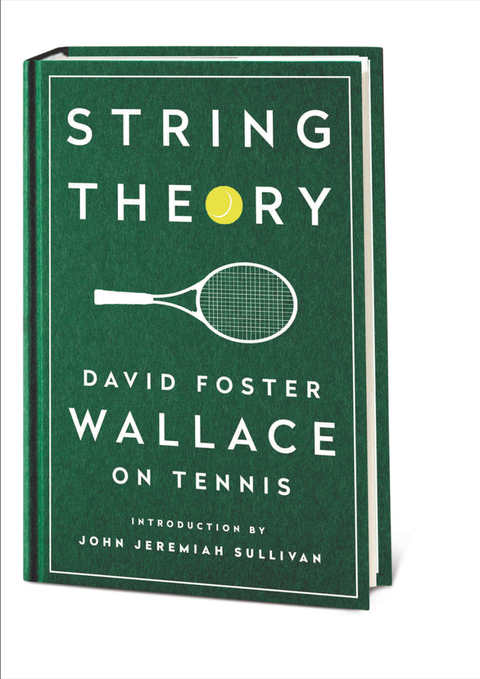
String Theory

 String Theory 

By David Foster Wallace


I've been meaning to read this book since I discovered its existence several years ago, and, inspired by this year's Australian Open (now several months in the past) I finally requested it via interlibrary loan. The book contains a series of essays on tennis, including a reflection on Wallace's own time as a nearly-high-level junior tennis player and on Roger Federer's greatness.

The essays are without exception fun to read. I love Wallace's voice; his is an equal mix of cynicism, awe, and wit. And the vocabulary! The man loves words. Example: "Goran Ivanisevic is large and tan and surprisingly good-looking -- at least for a Croat; I always imagine Croats looking ravaged and katexic and like somebody out of a Munch lithograph -- except for an incongruous and wholly absurd bowl haircut that makes him look like somebody i a Beatles tribute band." He does this for pages and pages and pages. Katexic! And then there are the footnotes, with which Wallace famously experimented in his novels. He does here, too, and they often take up more of a page than the regular text.

I will say that the essays definitely repeat some of the same themes. One of which is that we mere mortal tennis players have no idea how good pros are until we see it in person. It would therefore be best to mete these out throughout the year. Perhaps one essay per major? This will be a good gift for Dad.

Thursday, January 27, 2022

Norwegian Wood

 Norwegian Wood

By Haruki Murakami

Even after reading the book, I was a bit confused about the title. Music and art often play supporting roles in


Murakami novels, but putting a song in the title suggests it will take center stage. And while the song does appear several times in this story, I didn't quite get why the author would give it such significance. Then I read this New York Times review and the opening sentences cleared it up for me. It's the lyrics, silly: "I once had a girl, or should I say, she once had me." Which is the book in a nutshell. So I guess that's why I make my living teaching middle school and not writing book reviews. 

Anyway -- back to Murakami! Yes! The "I" in this story is a typical Murakami man, this time named Toru Watanabe. Like most of Murakami's main characters, he is a soul adrift and detached from the world. Despite his good nature and intelligence, he is inexplicably friendless in the busiest city in Japan. And he is haunted as he tries to make sense of a traumatic past.

The trauma in this story stems from the suicide of Toru's best (and only) high-school friend at the age of 17. It bubbles up when Toru, now studying at a Tokyo university, runs into his best friend's girlfriend, Naoko. The three were inseparable during their high school years -- a relationship that conjures Colorless Tsukuru Tazaki -- and become so again in this new stage of life, taking long walks on Sunday afternoons before Toru's shift at a record store. Naoko has a mesmerizing pull on Toru -- much like Murakami's effect on the reader -- and the two fall in "love". I put it in quotation marks because it is an attraction that seems to strive more  to make sense of their common friend's death than to take joy on one another.

Not long after they meet, Naoko moves to an sanitarium of sorts to recover from an unnamed mental illness. Toru visits her there, and, when he does so, enters an world separate from the seemingly inane drivers of "reality". This seems to be one of the central meditations of the book: Whether it is better to be of the world or detached from it. Symbolizing this choice is a relationship Toru develops with a fellow co-ed named Midori. As Midori explains after announcing her love for Toru: "I'm a real, live girl, with real, live blood gushing through my veins." In the end, Toru -- unlike many other characters in the book -- chooses real life.

I simply cannot imagine picking up a book whose sole plot is a love triangle. And that is Murakami's magic: It doesn't matter what he is writing about, his style and tone and mood draw you into world. Reading him is like being in a meditative trance. It's a place I haven't visited for a year or so, and I was glad, as always, to be back.  

Sunday, January 16, 2022

The Odyssey

 The Odyssey

A Graphic Novel by Gareth Hinds


Erin picked this up as something she might use for a mythology club that'll be running at school beginning in a few weeks. Since I was between books, I picked it up to. Given that it is a graphic novel, I ripped through it in an evening.

I guess what struck me about it, other than the pretty-cool graphics to go along with the story, was just how familiar it all is. I have no recollection of ever reading The Odyssey, though I must have at some point in school. It just feels like something running in the background of our culture. Which is pretty crazy given how old this story is. It is kind of amazing to think that humans have been telling and retelling the tale of Odysseus' travels for thousands of years. 

It is an idea that connects back to Cloud Cuckoo Land, which was certainly on my brain as I leafed through this book. It is interesting how the reading of one book can color your reading of another.