Saturday, March 19, 2022

Any Other Name

Any Other Name

By Craig Johnson

This is one of the installments in the book series that inspired the Longmire TV show. It features Walt


Longmire as a beleaguered but talented Wyoming sheriff who tackles outsized crimes in small-town America -- in cowboy style. I saw this at my friend Chris Sickel's house during a February trip to Montana, and I thought it would be an apropos read. I was right.

In this particular Longmire adventure, Walt is lured outside of his jurisdiction to a neighboring county, where the wife of the sheriff there wants him to look into his death. It had been labeled a suicide, but she thinks its more. The book is heavy on foreshadowing, and we learn pretty early on that the wife isn't going to like what Walt finds out. It turns out that the reason for the sheriff's death hits closer to home than she imagined. Spoiler alert: her daughter was running a sex-trafficking ring out of the family basement. When the sheriff-father uncovered it, he was unable to either turn his daughter in or continue to look the other way. So he killed himself.

I can't say this was a great book. The plot was far-fetched to say the least, and there are lots of hard-boiled detective meets good ole Wyoming boy cliche and shtick. But it was entertaining. Might have to pick up another one next time I am out west.

Sunday, March 13, 2022

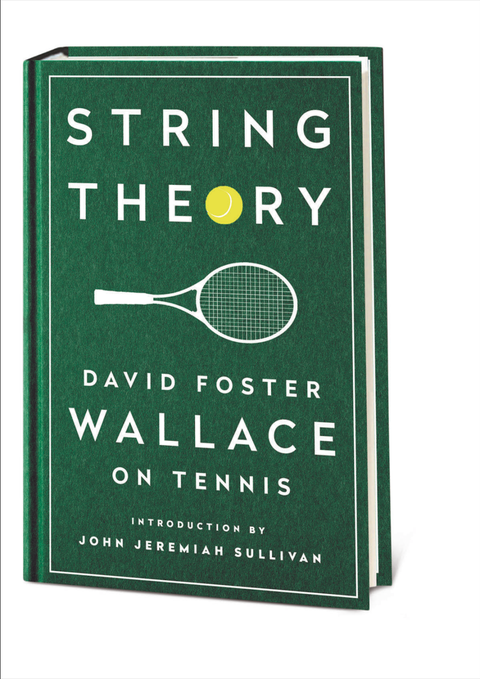
String Theory

 String Theory 

By David Foster Wallace


I've been meaning to read this book since I discovered its existence several years ago, and, inspired by this year's Australian Open (now several months in the past) I finally requested it via interlibrary loan. The book contains a series of essays on tennis, including a reflection on Wallace's own time as a nearly-high-level junior tennis player and on Roger Federer's greatness.

The essays are without exception fun to read. I love Wallace's voice; his is an equal mix of cynicism, awe, and wit. And the vocabulary! The man loves words. Example: "Goran Ivanisevic is large and tan and surprisingly good-looking -- at least for a Croat; I always imagine Croats looking ravaged and katexic and like somebody out of a Munch lithograph -- except for an incongruous and wholly absurd bowl haircut that makes him look like somebody i a Beatles tribute band." He does this for pages and pages and pages. Katexic! And then there are the footnotes, with which Wallace famously experimented in his novels. He does here, too, and they often take up more of a page than the regular text.

I will say that the essays definitely repeat some of the same themes. One of which is that we mere mortal tennis players have no idea how good pros are until we see it in person. It would therefore be best to mete these out throughout the year. Perhaps one essay per major? This will be a good gift for Dad.

Thursday, January 27, 2022

Norwegian Wood

 Norwegian Wood

By Haruki Murakami

Even after reading the book, I was a bit confused about the title. Music and art often play supporting roles in


Murakami novels, but putting a song in the title suggests it will take center stage. And while the song does appear several times in this story, I didn't quite get why the author would give it such significance. Then I read this New York Times review and the opening sentences cleared it up for me. It's the lyrics, silly: "I once had a girl, or should I say, she once had me." Which is the book in a nutshell. So I guess that's why I make my living teaching middle school and not writing book reviews. 

Anyway -- back to Murakami! Yes! The "I" in this story is a typical Murakami man, this time named Toru Watanabe. Like most of Murakami's main characters, he is a soul adrift and detached from the world. Despite his good nature and intelligence, he is inexplicably friendless in the busiest city in Japan. And he is haunted as he tries to make sense of a traumatic past.

The trauma in this story stems from the suicide of Toru's best (and only) high-school friend at the age of 17. It bubbles up when Toru, now studying at a Tokyo university, runs into his best friend's girlfriend, Naoko. The three were inseparable during their high school years -- a relationship that conjures Colorless Tsukuru Tazaki -- and become so again in this new stage of life, taking long walks on Sunday afternoons before Toru's shift at a record store. Naoko has a mesmerizing pull on Toru -- much like Murakami's effect on the reader -- and the two fall in "love". I put it in quotation marks because it is an attraction that seems to strive more  to make sense of their common friend's death than to take joy on one another.

Not long after they meet, Naoko moves to an sanitarium of sorts to recover from an unnamed mental illness. Toru visits her there, and, when he does so, enters an world separate from the seemingly inane drivers of "reality". This seems to be one of the central meditations of the book: Whether it is better to be of the world or detached from it. Symbolizing this choice is a relationship Toru develops with a fellow co-ed named Midori. As Midori explains after announcing her love for Toru: "I'm a real, live girl, with real, live blood gushing through my veins." In the end, Toru -- unlike many other characters in the book -- chooses real life.

I simply cannot imagine picking up a book whose sole plot is a love triangle. And that is Murakami's magic: It doesn't matter what he is writing about, his style and tone and mood draw you into world. Reading him is like being in a meditative trance. It's a place I haven't visited for a year or so, and I was glad, as always, to be back.  

Sunday, January 16, 2022

The Odyssey

 The Odyssey

A Graphic Novel by Gareth Hinds


Erin picked this up as something she might use for a mythology club that'll be running at school beginning in a few weeks. Since I was between books, I picked it up to. Given that it is a graphic novel, I ripped through it in an evening.

I guess what struck me about it, other than the pretty-cool graphics to go along with the story, was just how familiar it all is. I have no recollection of ever reading The Odyssey, though I must have at some point in school. It just feels like something running in the background of our culture. Which is pretty crazy given how old this story is. It is kind of amazing to think that humans have been telling and retelling the tale of Odysseus' travels for thousands of years. 

It is an idea that connects back to Cloud Cuckoo Land, which was certainly on my brain as I leafed through this book. It is interesting how the reading of one book can color your reading of another.

Saturday, January 15, 2022

A Burning

 A Burning

By Megha Majumdar

The literal burning of the title happens late at night at a train station, where shadows of men are seen


fleeing while one after another train car is lit ablaze. More than a hundred are left dead. 

Meanwhile, in a nearby slum, a young woman named Jivan is pondering this atrocity. When her previous Facebook posts on the incident fail to garner enough likes as she wanted, Jivan reposts a video of a weeping woman who declares that police were at the seen and failed to act and so isn't the state just as much a terrorist as the people who lit the flames in the first place.

Jivan, it is clear, is striving, hoping for more. She has dropped out of school for a clerk job at a fancy clothing store, where she brings home her family's first steady income in a long while. She wants to be seen, to be somebody. 

But, it seems, in modern India, Muslims are not destined to be somebodys.

Because, due to her post or some other motivation, Jivan is arrested for the crime that she has nothing to do with. The poor, Muslim girl becomes a scapegoat for the nation, a charade of justice that fools enough people. 

Along the way, Jivan's fall allows others to rise. There is her former physical education teacher, PT Sir, who parlays testimony as the accused's former teacher into a plum job with a rising nationalist political party. And Lovely, a hijra -- which, based on some quick research, I think is an Indian term for someone who is transgendered --  follows a similar path to a starring role in a new movie. Both make the conscious decision to quicken injustice for Jivan for a better life for themselves. 

There is a cruel irony running in the background. The nationalist political party to which PT Sir belongs, and which wins election amidst Jivan's trial, preaches service to the state, subordinating the self for the good of all. But is self-service that leads party leaders to doom Jivan to what they know is an unjust fate. It is a commentary not just on India but the facade of the zero-sum game that many seem to think they must play to get ahead throughout the world.

As a reader, I will say this was a difficult but mesmerizing one to get through. You are sympathetic to each character in their striving. But it is Jivan with whom your loyalty lies, and it is hard, at the outset, to imagine anything but justice coming her way. That it doesn't is a gut punch that will be a bit hard to recover from.

Monday, January 10, 2022

The Eye of the Needle

 The Eye of the Needle

By Ken Follett

I came across this book one evening after the kids had found and ransacked a box of books my parents' dropped off about a year ago. I was just off Cloud Cuckoo Land, and thought I'd give it a shot. It was a winner.

Set in England during World War II, the book tells the tale of a German spy whose codename is "The Needle" owing to his penchant for killing with a stiletto knife. As cover, he goes by Henry Faber. With D-Day approaching, German officials send Faber to East Anglia to assess the size of the army amassing there. What he finds is a ruse -- inflatable tanks, plywood planes, and half-built barracks designed to trick the Germans into thinking that the landing target will be Calais. Faber photographs the truth and sets about returning the information to Germany so it can better defend the true location, Normandy.

Standing in his way is Britain's Military Intelligence (MI), whose ranks have expanded to include the likes of Percival Godliman, a Medieval historian who served with distinction in the previous war. Godliman (whose name is, come on, a bit obvious) and his colleagues track Faber to a remote island off the coast of Scotland, where he awaits a rendezvous with a U Boat. But it is one of the inhabitants of the island, Lucy, who becomes the real hero. She and her husband, David, had sought refuge on the island four years before when a car accident on the couple's wedding night left David legless -- and humorless. When Faber shows up, they are initially just glad to see another human being, and Lucy especially so. She conducts a tryst with Faber, who becomes uncharacteristically smitten with Lucy and so holds off on killing her -- which becomes his fatal mistake.

Whoa, what a page turner this was! Full of fairly graphic violence and, toward the end, sex, this was more of a book than I bargained for. I'd picked it up expecting silly cliches, but by the end I couldn't put it down -- even though I knew what the outcome had to be. I might check out more Follett in the future.

Sunday, January 9, 2022

Still Life and A Fatal Grace

 Still Life and A Fatal Grace

By Louise Penny

I read these two mysteries, the first in the Armand Gamache series, back to back, and they are blurred in my head. In the first, a beloved community member is killed by an arrow. The search for the perpetrator leads investigators to her house, which the victim had kept under wraps from even her closest friends for decades. The reason, it turns out, was that it had been covered in folk art that held the clue to solving the crime. In the second, a decidedly unbeloved newcomer to the community was murdered at a post-Chritsmas curling match in an unusual way: through electrocution. On ice. In a crowd. The subsequent investigation revealed it was the victim's daughter, who had endured enough suffering at her mother's hand and mouth that no one could blame her for the crime.

But it isn't really the plot that keeps me coming back to these novels; it's the characters that really draw you in. There's Clara and Peter, the resident artists, and Ruth, the curmudgeonly poet, and Oivier and Gabri, the owners of the Three Pines Bistro, and, of course, Gamache himself, a man of inscrutable integrity and kindness who is, we learn, on the outs from the rest of the Surete because of his attempts to hold a fellow officer accountable. It is this drama that weaves through all of Penny's books. This stuff is literary candy -- I'm looking forward to going back for more.